Dental Implants in Roodepoort & Greater Johannesburg
Reviewed by Dr Chalita le Roux, BChD (cum laude) University of Pretoria · 2019 Dental Materials Prize · Academic Honorary Colours · HPCSA DP 0118702 · Member, South African Academy of Aesthetic Dentistry (SAAAD) · In private practice in Roodepoort since 2022. Last clinically reviewed: 1 May 2026
Replace missing teeth with fixed, natural-looking dental implants — designed to restore your smile, your confidence, and your ability to eat the food you love again.
If you’ve been hiding your smile in photos, avoiding hard or chewy foods, or feeling self-conscious in conversations because of a missing tooth, broken-down teeth or a denture that won’t sit comfortably, dental implants give you back what was always supposed to be there: a permanent, natural-feeling tooth that looks, feels, and works like the original. At our Roodepoort practice in Amorosa Office Park, Dr Chalita le Roux plans every implant case around your actual smile — the way you laugh, the way your lip frames your teeth, the way you want to feel when you next sit down for dinner with the people you love.
We place dental implants for patients across the Gauteng West corridor — Ruimsig, Krugersdorp, Little Falls, Honeydew — and for patients travelling in from greater Johannesburg specifically for cosmetic and same-day implant work. Patients travelling from further afield — including international visitors who combine treatment with a trip — can read our dental tourism guide for Roodepoort, Johannesburg.
At a glance — what to expect from us
- One clinician, start to finish — Dr Chalita plans, places and restores your implant herself, with bone grafting handled in-house.
- 3D-planned, digitally guided — your implant position is decided on a 3D CT scan before we ever pick up an instrument.
- Same-day CEREC restorations in selected cases — your final crown milled in our practice while you wait.
- SAAAD-accredited cosmetic dentistry — the aesthetic outcome is planned alongside the surgical placement, not after.
- Transparent, written treatment plan — itemised quote, ICD-10 codes, no surprises.
Book your dental implant consultation in Roodepoort
A real Roodepoort implant outcome
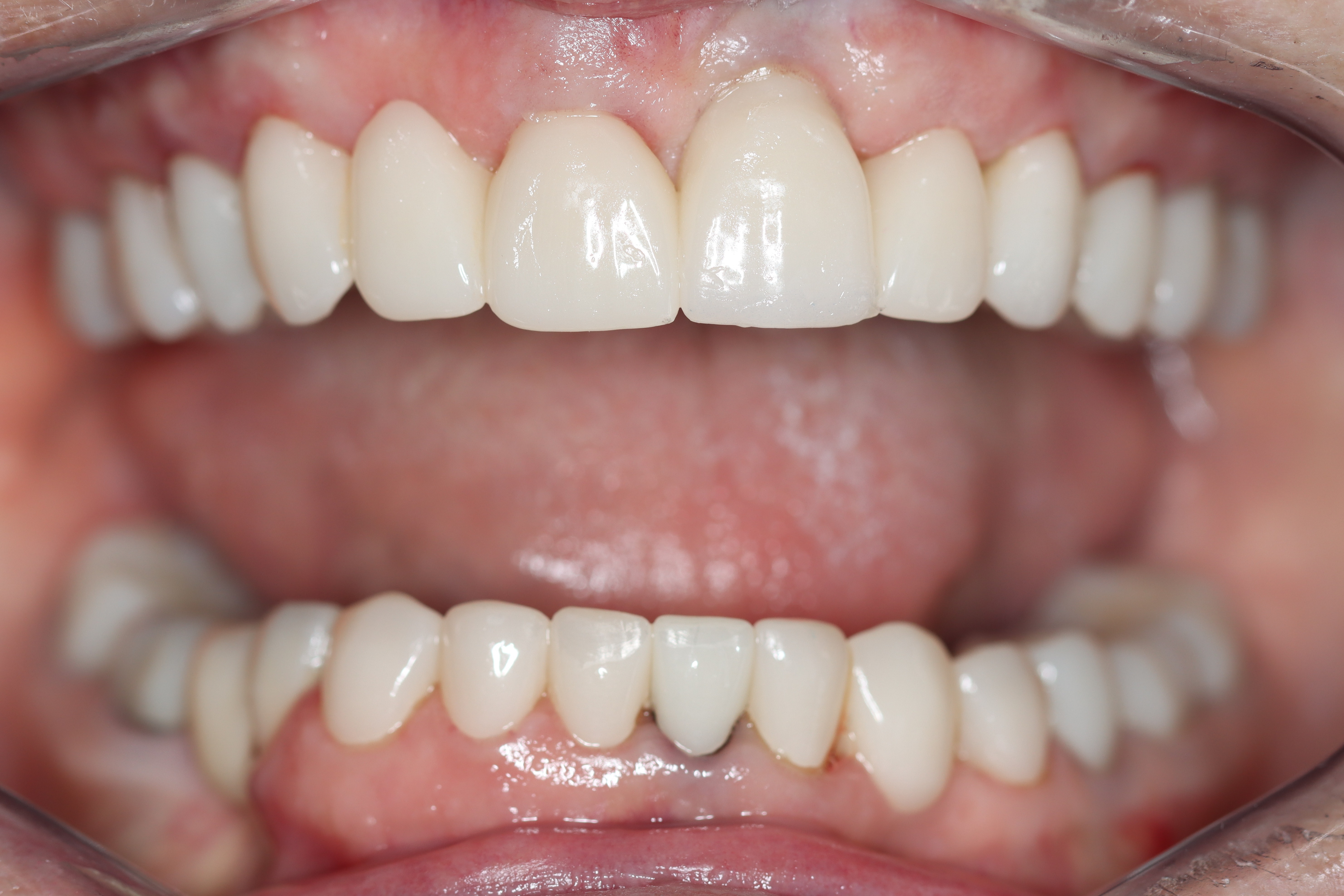
Before the long-form clinical detail below, here’s a recent full-mouth restoration from our Roodepoort practice. The implant component — a new colour-matched ceramic crown on an upper-anterior dental implant — was completed alongside new ceramic crowns on the remaining upper teeth, new crowns on the lower teeth, and a 3-unit bridge in the lower-right quadrant. (More cases further down the page.)
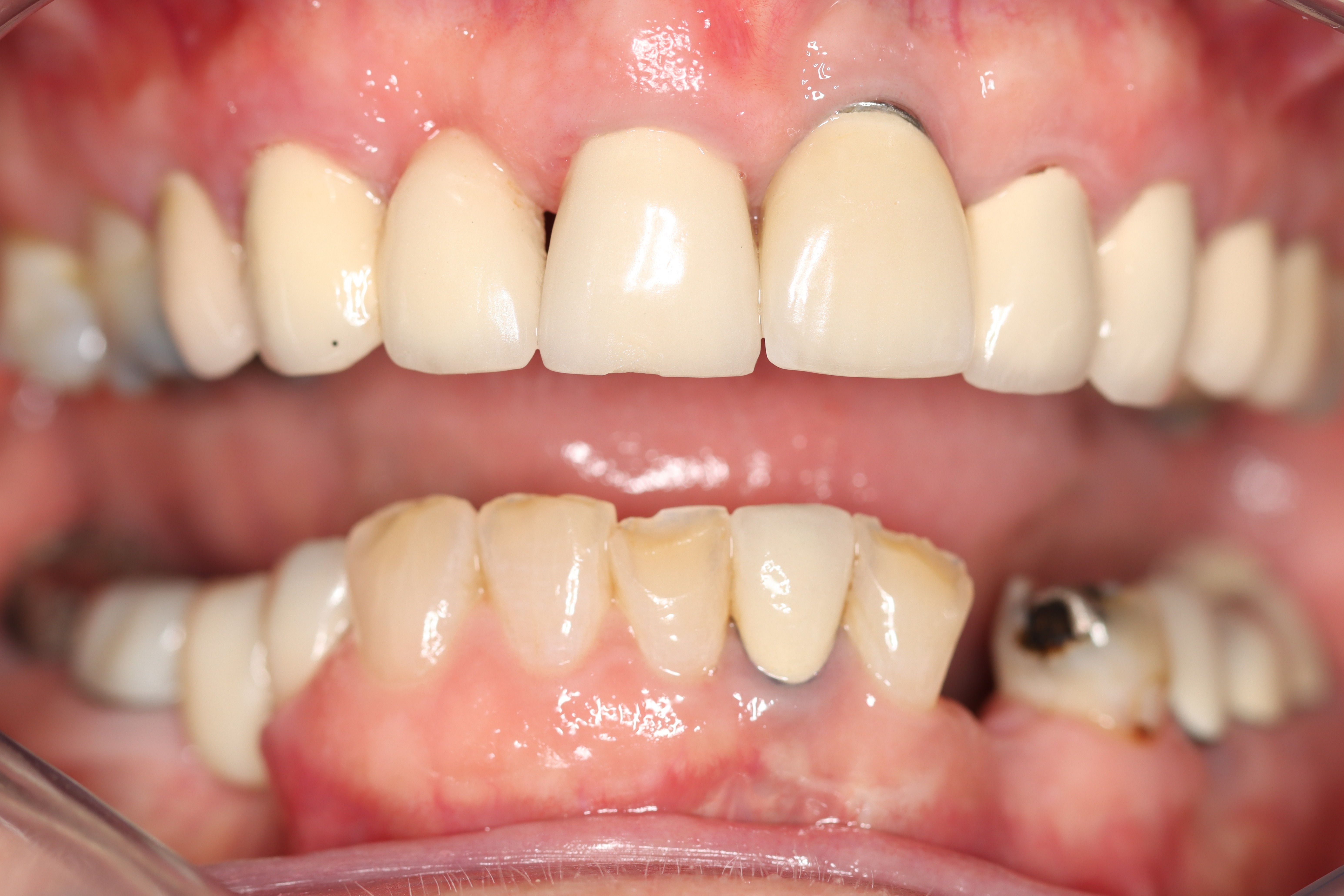
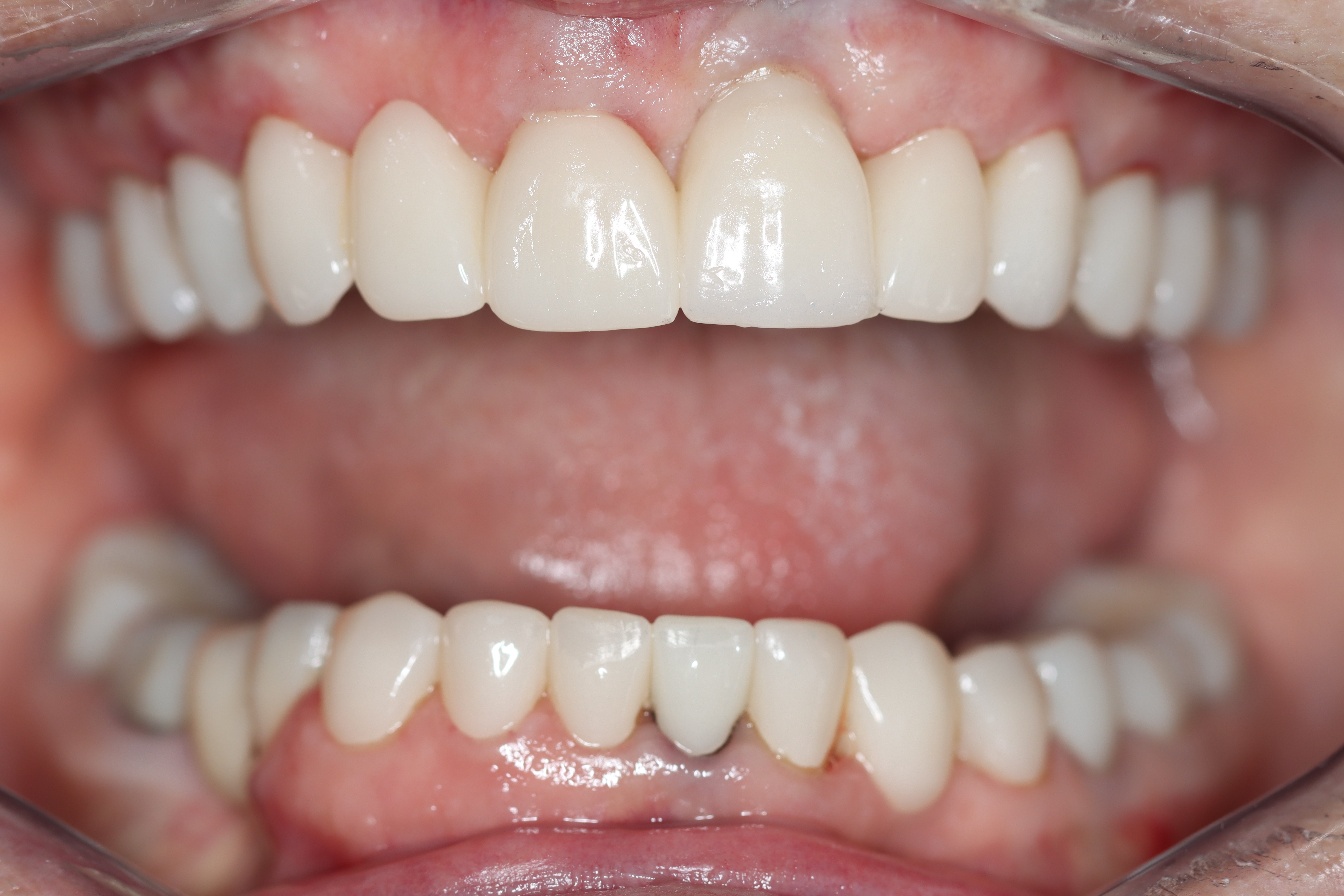
Treatment performed: full-mouth restoration. The patient’s existing upper-anterior dental implant was retained; the aged implant crown — which had a visible metal margin at the gum line — was replaced with a new colour-matched, all-ceramic implant crown. New ceramic crowns were placed on the remaining upper teeth, new crowns on the lower teeth, and a 3-unit bridge restored a missing tooth in the lower-right quadrant. Planned and delivered as one coordinated treatment by a single clinician.
This page goes on to explain what a dental implant is, the different types we place, the step-by-step procedure from your first consultation through to your final restoration, what it costs, and how implants differ from dentures — because the two are very often confused.
What is a dental implant?
A dental implant is a small, biocompatible titanium (or zirconia) screw that we place into your jawbone to replace the root of a missing tooth. Once the implant has fused with the bone — a healing process called osseointegration — it acts as a permanent anchor for a crown, a bridge, or, in larger cases, a full arch of new teeth.
Unlike a denture, which sits on top of the gum and can move, an implant is fixed into the bone exactly where the original tooth root used to be. It does not slip, it does not need adhesive, and it does not need to be removed at night. With good oral hygiene and routine check-ups, a well-placed dental implant can last a lifetime.
The three working parts of an implant are:
- The implant body — the titanium fixture that integrates with the bone.
- The abutment — a small connector that joins the implant to the new tooth.
- The crown, bridge or denture restoration — the visible “tooth” that sits on the abutment, designed to match the shade and shape of your natural teeth.
Types of dental implants we offer in Roodepoort
Implants are not one-size-fits-all. The right solution depends on how many teeth are missing, the quality of your jawbone, and what you want the final result to look and feel like. In our Roodepoort practice we offer three primary categories.
Single-tooth dental implants
For one missing tooth, we place a single implant and restore it with a crown. We use CEREC same-day technology wherever the case allows, which means the final crown is digitally designed and milled in-practice rather than sent to an external lab. The neighbouring teeth are left completely untouched — a key advantage over a traditional bridge, which requires the teeth on either side to be cut down.
Multiple-tooth implants (implant-supported bridges)
When you are missing two, three or four teeth in a row, we don’t necessarily need an implant for every tooth. Two well-placed implants can support a multi-unit bridge, restoring the full row with fewer surgical sites and lower cost than placing individual implants for each missing tooth.
Full-arch and All-on-4 dental implants
If you are missing all the teeth in your upper or lower jaw — or if your remaining teeth are failing and need to be removed — a full-arch implant solution replaces the entire arch on as few as four implants. This is often called “All-on-4” or “teeth in a day”. You walk in with failing or missing teeth and walk out the same day with a temporary fixed bridge anchored to the implants. The final restoration is fitted once healing is complete, usually within three to six months.
This is a fundamentally different solution from dentures. The teeth are fixed; you cannot remove them at home; you eat, speak and smile as you would with natural teeth.
The dental implant procedure step by step
Every implant case at our Roodepoort practice follows the same carefully sequenced patient journey. We do not place implants without thorough planning — bone, gum and bite all need to be assessed before we touch a drill.
- Consultation and digital scan — we listen to what you want, examine your mouth, and take digital impressions and clinical photographs.
- 3D CT imaging (CBCT) — a low-dose 3D scan that shows us exactly where the bone is dense enough to receive an implant, and where vital structures like nerves and sinuses are. This is non-negotiable for safe, predictable placement.
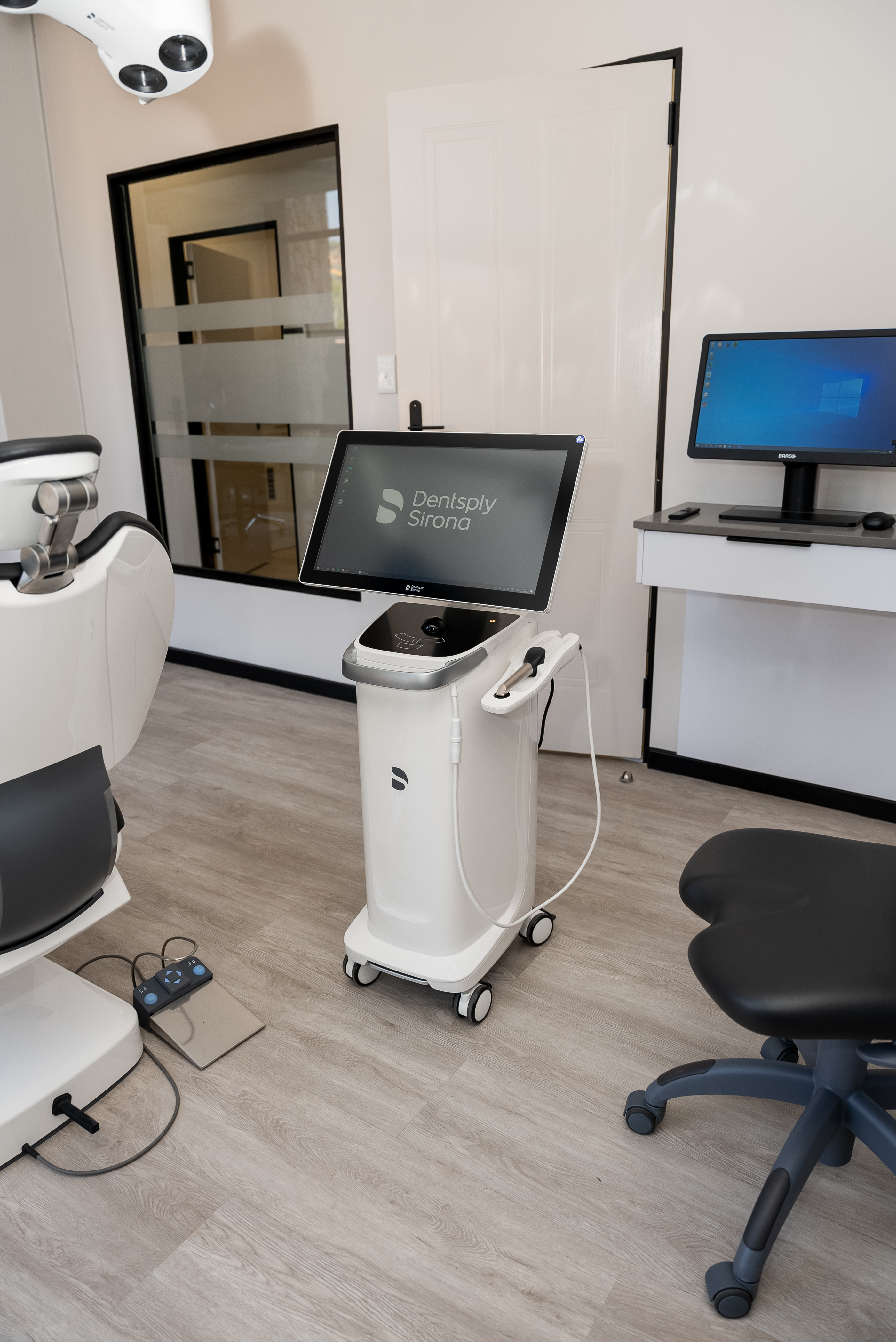
- Treatment planning — we plan the implant position digitally before surgery so the angle, depth and final crown position are decided in advance.
- Implant placement (surgical phase) — performed in our Amorosa Office Park surgery under local anaesthetic, usually with conscious sedation if you would prefer to be relaxed throughout. A single-tooth placement typically takes 45–60 minutes.
- Osseointegration (healing phase) — three to six months for the implant to fuse with the bone. You wear a temporary tooth or bridge during this time so you are never without a smile.
- Restoration (prosthetic phase) — once the implant is fully integrated, we fit the abutment and the final crown, bridge or arch. Where appropriate, the final crown is milled the same day with our CEREC system.
- Follow-up and maintenance — six-month hygiene appointments and an annual implant review for the life of the restoration.
At a glance — your implant timeline
- Day 1: Consultation, 3D scan, digital plan
- Surgical day: 45–60 min placement under local anaesthetic
- 3–6 months: Osseointegration (you wear a temporary tooth)
- Final fitting: Abutment + crown — same-day CEREC where the case allows
- Ongoing: 6-month hygiene, annual implant review
Roodepoort-based implant consultations — speak to our practice in Amorosa Office Park about your implant options →
Healing, osseointegration and your timeline
Most patients ask the same question first: how long until I have a finished tooth? The honest answer depends on the case.
- Single-tooth implant, healthy bone: approximately three to four months from placement to final crown.
- Multiple-tooth bridge: four to six months, depending on whether bone grafting is needed.
- Full-arch / All-on-4: a temporary fixed bridge on the day of surgery; the final permanent prosthesis fitted four to six months later.
- With bone graft: add three to six months of pre-surgical healing before the implant can be placed.
You will not be in pain for months on end. The discomfort window after surgery is typically 48–72 hours and is well managed with standard prescription pain relief. Most of our patients return to work the next day for a single-tooth case.
Cost of dental implants — and what affects it
Cosmetic and restorative work is highly individual — every smile presents a different combination of conditions, materials, and treatment depth. We don’t publish individual fees because they would mislead more than they inform. Your consultation generates a personalised treatment plan with a transparent written estimate before any treatment begins. Book a consultation in Roodepoort to receive yours.
Treatment fees are confirmed at consultation; we don’t publish individual figures because every plan is personalised.
| Treatment |
|---|
| Single dental implant (surgery + abutment + crown) |
| Multiple-tooth implant bridge (per arch section) |
| Full-arch / All-on-4 (per arch) |
| Bone graft (where required, in addition) |
Factors that affect your final cost:
- Implant brand — we work with internationally recognised systems including Straumann, Nobel Biocare and MIS, chosen on a case-by-case basis. Premium brands carry a higher fee but a longer clinical track record.
- Number of implants — fewer implants supporting more teeth (e.g. All-on-4) is more cost-efficient than placing a separate implant for every missing tooth.
- Bone grafting — required if the jawbone has shrunk after long-term tooth loss. (Sinus lifts, when needed, are referred to a specialist.)
- Restoration material — ceramic vs zirconia vs hybrid acrylic for the final tooth.
- Sedation preferences — local anaesthetic only, or conscious sedation.
We provide you with a detailed treatment plan and ICD-10 codes that you can submit to your medical aid in advance, so you know what your scheme will cover before treatment begins.
Medical aid — which components are typically covered?
South African medical aids treat implant components differently. Below is a general guide; your specific scheme and plan tier will determine the actual benefit.
| Treatment component | Typical medical-aid treatment |
|---|---|
| Surgical implant placement | Usually classified as specialised dentistry; partial cover on top-tier plans; nil on most hospital-only plans |
| Abutment | Sometimes covered as a dental prosthesis benefit; varies by scheme |
| Crown / bridge / arch restoration | Often covered in part under dental prosthesis benefits, subject to annual limits |
| Bone graft | Variable — some schemes cover under specialised dentistry, others exclude entirely |
| 3D CBCT scan | Often covered under radiology benefits with the right ICD-10 codes |
| Conscious sedation | Variable; usually requires pre-authorisation |
We provide you with a complete written treatment plan and ICD-10 codes that you can submit to your medical aid for pre-authorisation before treatment begins, so you know exactly what is and isn’t covered. Reimbursement depends on your scheme and plan tier — please confirm benefits with your medical aid directly.
Bone grafting — when bone is “not enough”
A common reason patients are told they “can’t have an implant” is insufficient jawbone — usually because the bone has shrunk after a tooth has been missing for years (atrophy) or because of past gum disease. Modern bone grafting is now routine and predictable:
- Socket preservation graft — placed at the time of tooth extraction to prevent bone loss before a future implant.
- Lateral or vertical augmentation — adds bone width or height to a healed ridge ahead of implant placement.
- Sinus lift (referred to a specialist) — lifts the sinus floor in the upper back jaw to create space for an upper-back-molar implant where bone is naturally thin. We don’t perform sinus lifts in-house, but we co-ordinate the referral and timing so the implant placement that follows happens with us.
Healing after a graft typically takes three to six months before the implant can be placed. We confirm exactly what is needed from your 3D CBCT scan. Bone grafts are performed in-house at our Roodepoort practice — so the same clinician who plans your implant also handles the graft, with no separate referral. Sinus lifts, when indicated, are referred to a trusted specialist; we co-ordinate the timing so that your implant placement happens with us once the lift has healed.
Same-day implant restoration with CEREC
In selected cases, we can complete the final restoration on the implant the same day the implant has integrated. Our in-practice CEREC system scans the integrated implant abutment, designs the crown digitally, and mills it from a single ceramic block while you wait — typically 60–90 minutes from scan to fitted crown. This spares you a separate restoration appointment and the temporary crown that traditional workflows require for two to three weeks.
CEREC same-day final crowns aren’t suitable for every implant case — bone quality, gum healing and bite forces all factor in — but where they are, we’ll offer it. See our same-day dentistry page for the full CEREC workflow.
Dental implants vs dentures — what’s the difference?
This is the single most common confusion we encounter, so it is worth being clear: a dental implant is not a denture, and our practice does not place removable dentures as a primary service.
A denture is a removable plastic or acrylic appliance that sits on top of the gum and is taken out at night. It restores the appearance of teeth but rests on soft tissue, can move when you eat or speak, and tends to accelerate jawbone shrinkage over time because the bone is no longer being stimulated by tooth roots.
A dental implant is a permanent titanium root surgically placed into the jawbone. It restores both the tooth and the root function, so the bone is preserved, your bite force is normal, and the new tooth does not move. Implants are not removed at night, do not need adhesive, and are cared for like natural teeth.
If you are currently in a denture and want a fixed, permanent solution, an implant-supported bridge or All-on-4 is almost always the upgrade you are looking for.
Dental implants as part of a smile makeover
For many patients, an implant is rarely a stand-alone procedure. It’s the foundation that makes a broader smile transformation possible — particularly where teeth have been missing for years, where existing crowns and veneers no longer match, or where a single failing tooth has held back the rest of a smile from being designed properly.
At our Roodepoort practice, dental implants integrate naturally with the rest of our cosmetic dentistry and smile makeover work because the same clinician — Dr Chalita le Roux — plans the surgical, restorative, and aesthetic outcomes together. That matters when:
- Implants are placed alongside porcelain veneers or crowns on the surrounding teeth, so the implant restoration matches the colour, shape and translucency of the rest of the smile.
- Full-mouth aesthetic rehabilitation combines implants for missing teeth with crowns or veneers on remaining teeth — re-establishing bite, lip support and a unified smile in a single coordinated plan.
- An implant-supported bridge or All-on-4 replaces a failing dentition with a fixed, full-arch restoration designed around your face, your lip line, and the way you smile — not just the gap.
- Same-day CEREC restorations allow the final crown on an integrated implant to be milled in our practice the day it’s fitted, so the implant work and the cosmetic outcome are completed in one workflow rather than two.
Because surgical placement, prosthetic restoration, and smile-design aesthetics happen under one roof, you don’t end up with mismatched crowns, an implant tooth that looks “different” from its neighbours, or three different opinions on what your smile should look like. The plan is one conversation, one clinician, one outcome.
If you’re considering an implant and you’ve already been thinking about whitening, veneers, or replacing older crowns, it’s worth booking a smile makeover consultation rather than a stand-alone implant assessment — we’ll plan everything as one project rather than as separate stages.
Are you a good candidate for dental implants?
Most adult patients are candidates for dental implants, but a few clinical factors materially improve the odds of long-term success. We assess all of these at your first consultation.
- Healthy gums — active gum disease must be treated and stabilised before implant placement.
- Sufficient jawbone density — confirmed on 3D CT scan; bone grafting is available where bone is insufficient.
- General health — uncontrolled diabetes, certain autoimmune conditions and ongoing chemotherapy can affect healing and need to be managed first.
- Non-smoker (or willing to stop) — smoking significantly increases the risk of implant failure; we strongly recommend stopping at least eight weeks before surgery.
- Adult skeletal maturity — usually age 18+; implants are generally not placed in children whose jaws are still developing.
- Realistic time commitment — most cases take three to six months from start to finish.
- Good oral hygiene habits — implants need daily brushing, flossing and routine professional cleanings to last decades.
- No untreated tooth grinding (bruxism) — manageable with a night guard, but must be addressed.
- Stable mental and physical health for surgery — implant placement is a minor surgical procedure performed under local anaesthetic.
If you are unsure whether you qualify, the only honest way to know is a consultation with a 3D scan. We will tell you frankly whether implants are right for you, and what the alternatives are if they are not.
Why patients choose Dr Chalita for implants
- Roodepoort-based, easy to reach — our practice is in Amorosa Office Park, with on-site parking and quick access from the N1, N14 and Hendrik Potgieter Road. Patients travel from Krugersdorp, Ruimsig, Little Falls, Honeydew and greater Johannesburg.
- SADA member and HPCSA registered — Dr Chalita le Roux is a registered member of the South African Dental Association and the Health Professions Council of South Africa, in private practice in Roodepoort since 2022.
- Female-owned, calm, modern practice — our patients consistently tell us our chairside manner is the reason they refer family.
- Same-day CEREC restorations — our in-practice CEREC system means single-implant crowns can often be designed, milled and fitted on the same day the implant has integrated, sparing you a separate restoration appointment and a temporary that lasts for weeks.
- 3D CBCT planning on every case — no implant goes in without a 3D scan and digital plan.
- Premium implant systems only — Straumann, Nobel Biocare and MIS, chosen for the case rather than for the margin.
- Transparent pricing and written treatment plans — you get the full plan, the alternatives, and the cost before any work starts.
Why our SAAAD membership matters
Most general dentists offer cosmetic procedures; only a small group of South African dentists are accredited members of the South African Academy of Aesthetic Dentistry (SAAAD). SAAAD membership signals a structured, ongoing commitment to aesthetic dentistry training beyond the standard BChD curriculum — covering smile design, ceramic restoration, photographic documentation, and case-based peer review.
For implant work in particular — where the final crown, bridge or arch must blend invisibly into your natural smile — this is the difference between a dentist who can place an implant and a dentist who has chosen to specialise their continuing education on how the final restoration looks. You can verify Dr le Roux’s SAAAD membership directly at saaad.co.za.
Real tooth-replacement and restorative cases at our Roodepoort practice
The cases below are from our Amorosa Office Park surgery. These are bridge and restorative outcomes — relevant to multi-tooth implant work and to single-tooth implant restorations. Patient identities are withheld; what’s shown is the cosmetic and functional outcome.
Case 1 — Full-mouth restoration with anterior implant crown
Treatment: Full-mouth restoration combining a new colour-matched implant crown on the existing upper-anterior implant, new ceramic crowns on the remaining upper teeth, new crowns on the lower teeth, and a 3-unit bridge in the lower-right quadrant. The aged implant crown showed a visible metal margin at the gum line, which is what led the patient to seek treatment; the implant itself was sound and was retained. Planned and delivered by a single clinician as one coordinated treatment.
Case 2 — 3-unit dental bridge replacing a missing front tooth
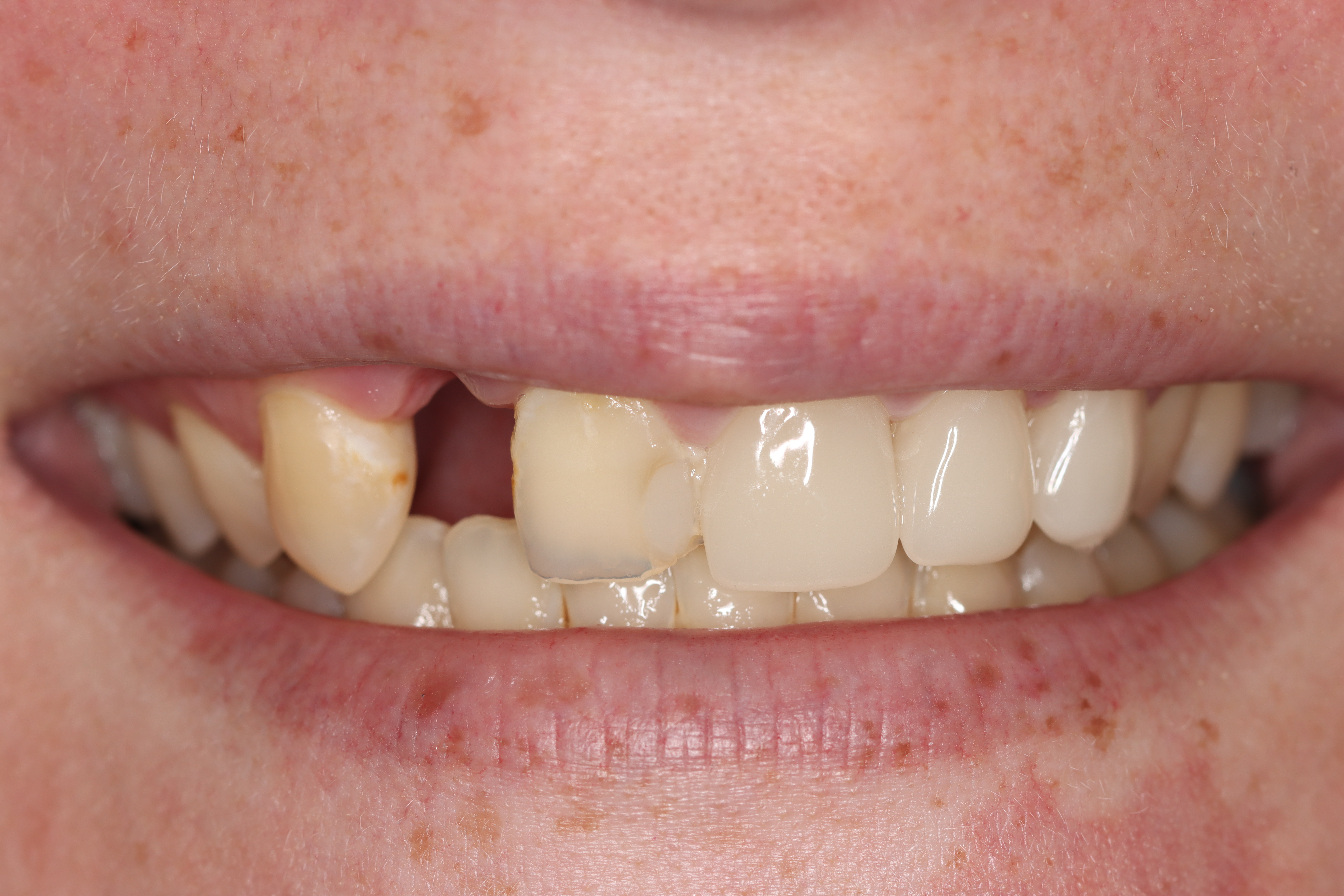
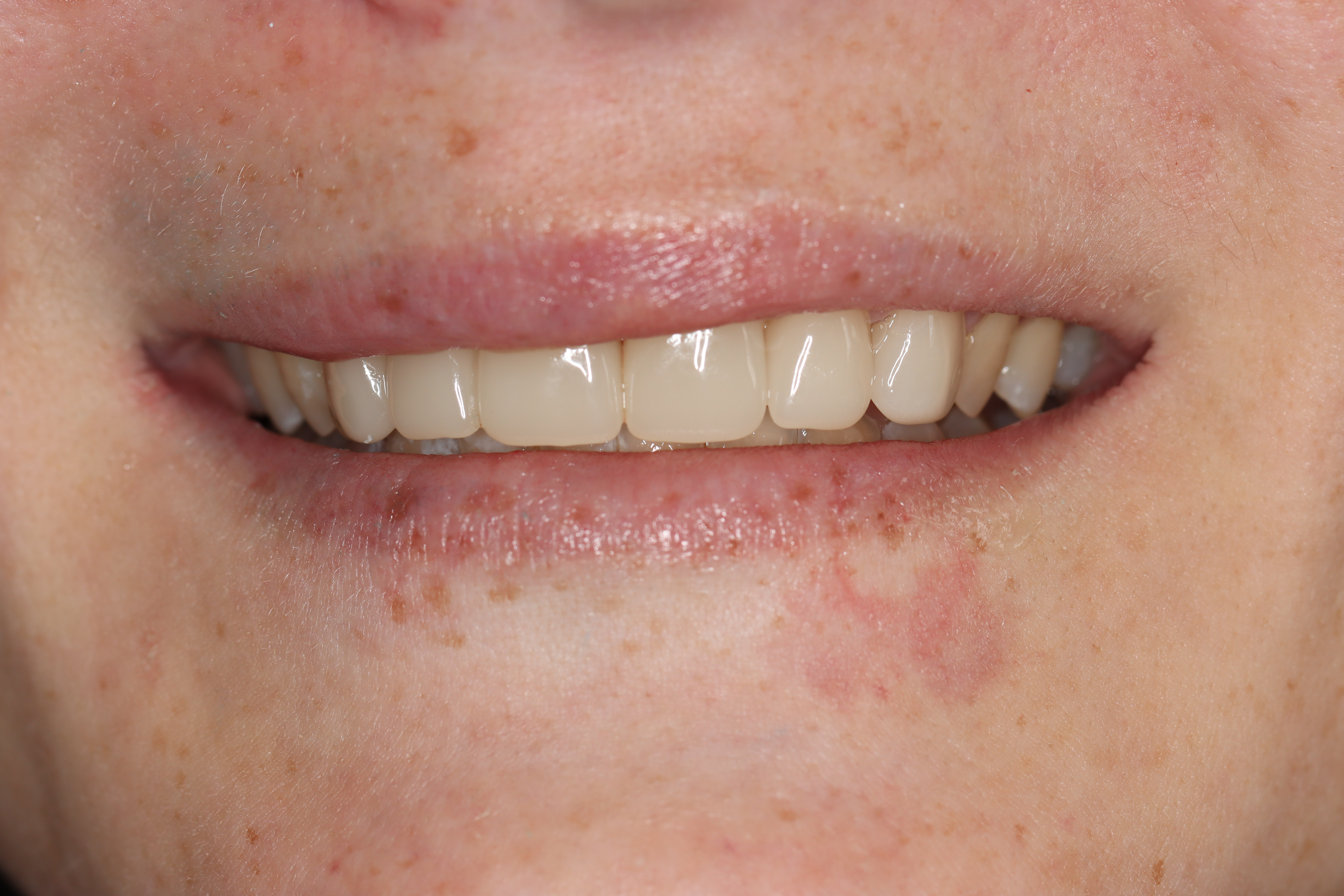
Treatment: Conventional 3-unit dental bridge restoring an upper-front tooth where there was sufficient adjacent tooth structure to support the bridge. This is the alternative to a single-tooth implant when the neighbouring teeth themselves need crowning, since the bridge serves both purposes in one restoration. Tooth shape, shade and translucency planned to match the rest of the smile.
Case 3 — Dental bridge replacing a missing anterior tooth
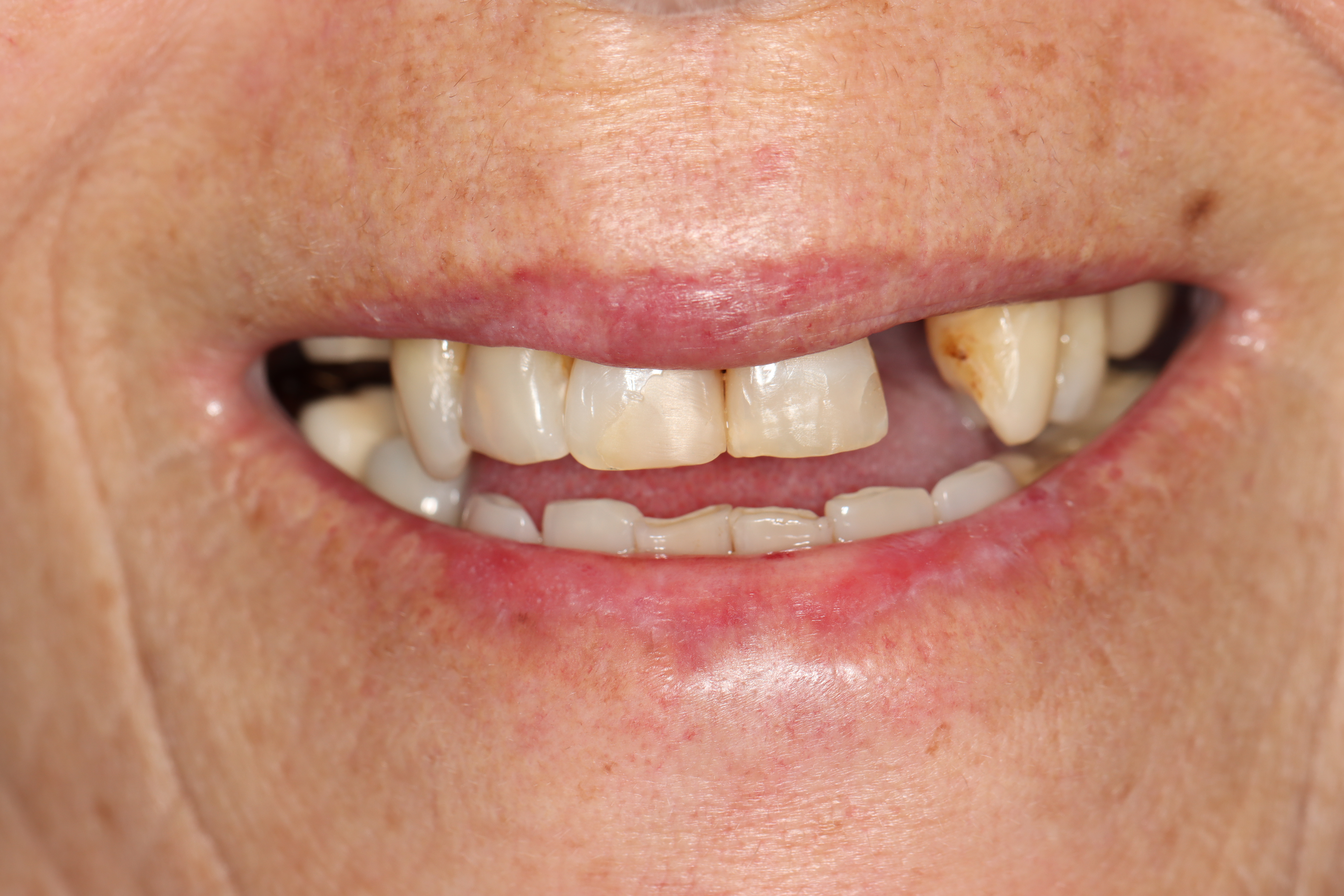
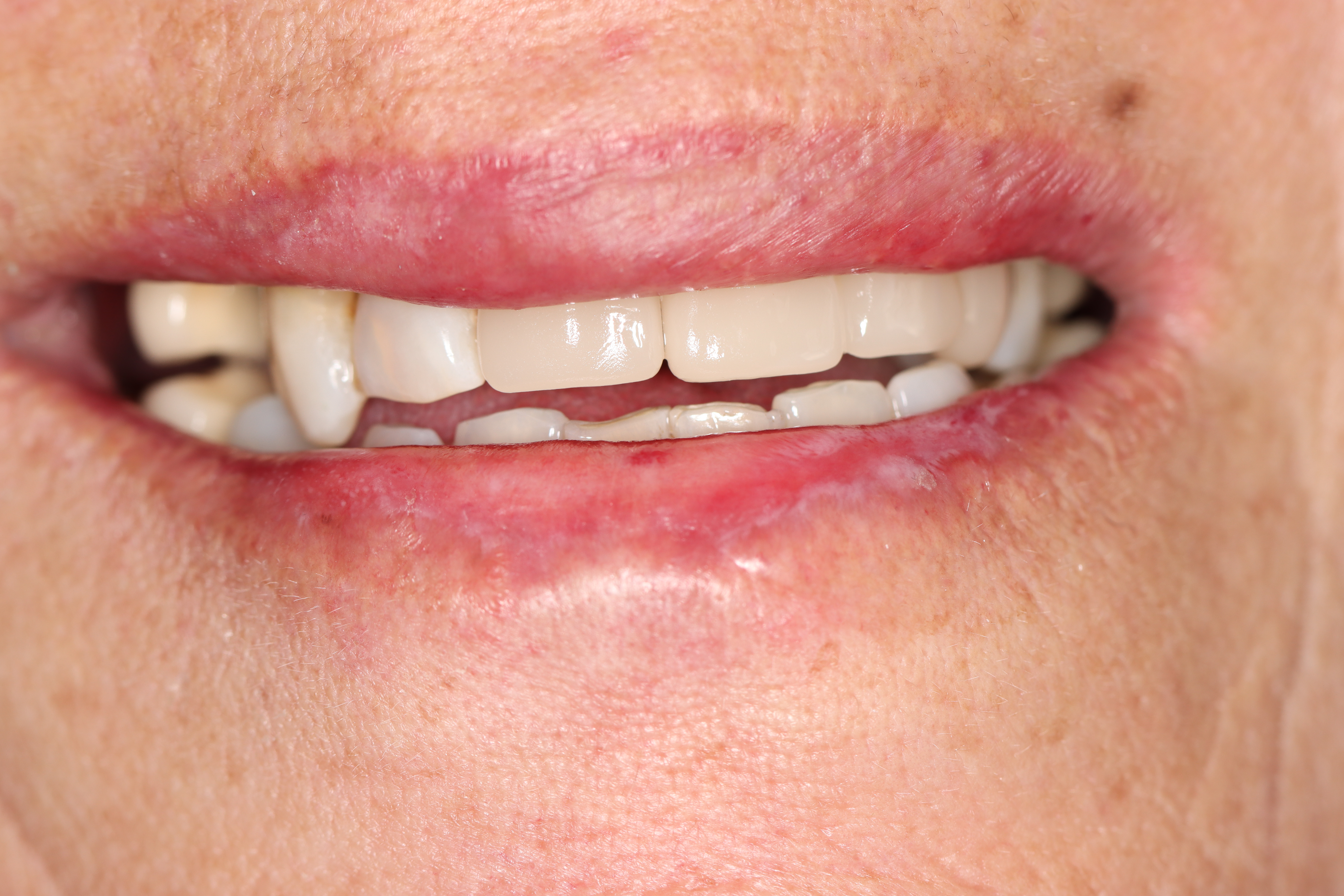
Treatment: Dental bridge replacing a missing anterior tooth. Where bone volume or general health rules out an implant, a bridge remains a predictable, fixed alternative that closes the gap and restores chewing function and the smile line. Outcome shown after the bridge has settled and the surrounding gum has healed.
Why our patients choose us — at a glance
- One clinician, full continuity — Dr Chalita plans, places and restores; no hand-offs, no mismatched outcomes.
- In-house bone grafting — fewer referrals, fewer visits, faster path to a finished tooth.
- 3D-planned, digitally guided — implant position decided before the drill ever moves.
- Same-day CEREC restorations — final crown milled in our practice while you wait, where the case allows.
- SAAAD-accredited cosmetic dentistry — the aesthetic outcome is planned alongside the surgical placement.
- Premium implant systems — Straumann, Nobel Biocare and MIS, chosen on a case-by-case basis.
- Single-practitioner practice — calm rooms, no rushed appointments, no impersonal hand-offs.
Frequently asked questions about dental implants
1. How long does a dental implant last? A well-placed, well-maintained implant can last a lifetime. The crown on top of the implant typically has a clinical lifespan of 10–20 years and may eventually need replacement, but the implant itself often does not.
2. Is the dental implant procedure painful? The placement is performed under local anaesthetic, so you feel pressure but not pain during surgery. Post-surgical discomfort is usually mild to moderate for 48–72 hours and is managed with standard prescription analgesics. Most patients describe the recovery as easier than they expected — easier, in many cases, than a tooth extraction.
3. What if I don’t have enough bone for an implant? We routinely place implants in patients who were told elsewhere they “don’t have enough bone”. Modern bone grafting can rebuild the jawbone to a depth sufficient for safe implant placement; where a sinus lift is needed first, we co-ordinate that with a trusted specialist before placing the implant ourselves. The 3D CT scan tells us exactly what is needed.
4. How many appointments will I need? A typical single-tooth case involves four to six appointments: consultation, 3D scan and planning, placement surgery, suture review, restoration fitting, and follow-up. Full-arch cases involve more appointments but condense the placement and temporary teeth into a single surgical day.
5. Can I have a same-day implant? In selected single-tooth cases — especially where a tooth is being extracted and immediately replaced — we can place the implant and a temporary tooth on the same day. Our CEREC system also allows the final crown to be designed and milled in-practice once healing is complete, often saving a separate appointment. Whether your case is suitable for “teeth in a day” depends on bone quality, gum health and bite forces; we confirm this from your 3D scan.
6. Will my medical aid cover dental implants? Most South African medical aids classify implants as specialised dentistry, which means coverage varies widely. Some plans pay a partial benefit; others pay nothing. We provide a full written treatment plan with ICD-10 codes that you can submit to your medical aid in advance so you know exactly what is and isn’t covered before treatment begins.
7. How long is the healing time after implant surgery? Soft-tissue healing (the gum) takes one to two weeks. Osseointegration (the implant fusing with the bone) takes three to six months. You wear a temporary tooth during this time, so you are never without a smile.
8. Are dental implants safe? Dental implants have one of the highest success rates of any implanted medical device — typically 95–98% over ten years when placed in a healthy mouth. The titanium used has been in clinical use since the 1960s and is well understood by the body.
9. Can dental implants be rejected by the body? Genuine “rejection” in the immune sense is extremely rare because titanium is biocompatible. What can happen is implant failure due to infection, smoking, uncontrolled diabetes or excessive bite force — all of which we screen for and manage.
10. How do dental implants compare to a bridge? A traditional bridge requires the healthy teeth on either side of the gap to be cut down to support the bridge. An implant is freestanding and leaves the neighbouring teeth completely untouched. Implants also preserve jawbone, which a bridge does not. For most single-tooth cases in patients with healthy bone, an implant is the better long-term investment.
11. Can I get implants if I’m a smoker? You can, but the success rate is lower. Smoking restricts blood flow to the gums and significantly increases the risk of implant failure. We strongly recommend stopping smoking at least eight weeks before surgery and ideally permanently. We will discuss this honestly with you at your consultation.
Patients travel to our Roodepoort practice from across Gauteng
Many of our cosmetic, smile-makeover, and same-day CEREC patients travel to Amorosa Office Park from estates and suburbs well outside the immediate Roodepoort catchment. Common origins include Krugersdorp (Noordheuwel, Monument, Krugersdorp West, Rant-en-Dal), Featherbrooke Estate, Steyn City, Blair Atholl Equestrian Estate, Midstream Estate, Waterfall Estate, Dainfern, Centurion, Pretoria, and Rosebank.
Why? Three reasons recur across patient feedback: 1. Same-day CEREC restorations replace what is otherwise a two- or three-visit treatment plan elsewhere — a single Roodepoort visit saves multiple round-trips. 2. Cosmetic dentistry, smile design, and facial aesthetics are offered under one roof — most local dental and aesthetic clinics specialise in one or the other. 3. SAAAD-accredited cosmetic dentistry is genuinely scarce; for high-value smile work, patients travel for the credential.
Our area-specific patient guides outline routes, drive times, and the practical reasons patients from these areas have made the journey worthwhile: – Cosmetic Dentist for Krugersdorp Patients – Emergency Dentist in Roodepoort for Krugersdorp Patients – Dentist for Noordheuwel & Monument Patients – Cosmetic Dentist for Steyn City Patients – Cosmetic Dentist for Blair Atholl Estate Patients – Cosmetic Dentist for Midstream Estate Patients – Cosmetic Dentist for Featherbrooke Estate Patients – Cosmetic Dentist for Waterfall Estate Patients – Cosmetic Dentist for Dainfern Patients – Cosmetic Dentist for Centurion Patients – Cosmetic Dentist for Pretoria Patients – Cosmetic Dentist for Rosebank Patients – Cosmetic Dentist for Ruimsig & Eagle Canyon Patients – Cosmetic Dentist for Honeydew & Cresta Patients – Cosmetic Dentist for Bryanston & Sandhurst Patients
If you would like to know whether implants are the right solution for you, the next step is a consultation, an oral exam and — when indicated — a 3D scan. You will leave with a written, itemised treatment plan and transparent estimate, so you know exactly what your options are and what the timeline looks like.
Visit us in Amorosa Office Park, Roodepoort
Call 071 884 3204 Book online Get directions
The fastest way to reach us is to WhatsApp Dr Chalita on 083 710 9131 — most messages are answered within the same working day. You can also call 071 884 3204 or book online via our contact form.
Dr Chalita le Roux Inc. · Amorosa Office Park · Roodepoort, Gauteng SADA member · HPCSA registered · CEREC same-day technology
About the author — Dr Chalita le Roux
Dr Chalita le Roux (née Johnson) is the founding dentist of Dr Chalita le Roux Inc. in Amorosa Office Park, Roodepoort. She graduated cum laude from the University of Pretoria with a Bachelor of Dental Surgery, where she was awarded the 2019 Dental Materials Prize and Academic Honorary Colours. She is a registered dentist with the HPCSA (DP 0118702) and a member of the South African Academy of Aesthetic Dentistry (SAAAD). Dr le Roux has been in private practice in Roodepoort since 2022, where she focuses on cosmetic dentistry, smile design, same-day CEREC restorations, and facial aesthetics, alongside comprehensive general and family dentistry. Her practice serves patients from Roodepoort, Krugersdorp, Ruimsig, and the wider greater Johannesburg area.
Clinical references
The clinical guidance on this page draws on:
International Journal of Oral & Maxillofacial Implants. 10-year survival rates of single-tooth implants — typically 95–98% in published meta-analyses. — supports the §FAQ-8 safety claim. Journal of Prosthetic Dentistry. Restoration outcomes on implant abutments. — informs the longevity expectations in §FAQ-1. Clinical Oral Implants Research. Bone-graft outcomes prior to implant placement. — supports the bone-grafting sub-section. South African Dental Journal (SADJ). Commentary on implant standards in SA practice. — informs the procedure-step framing in §3.
This information is for patient education and does not constitute medical advice. Treatment recommendations are individual; please consult Dr le Roux for a personal assessment.
We see patients from across Roodepoort and Greater Johannesburg. Patients travelling in for this service often come from: Randburg Northcliff Bryanston Helderkruin Wilropark Weltevreden Park.