“Can you just put crowns on and make them white?” is one of the most common questions we hear about a smile makeover — and for this patient the honest answer was: not yet. Before a single crown was designed, the gum line had to be corrected with a procedure called a gingivectomy. Here is that case in the order it actually happened, and what it shows about how a smile makeover is planned.
The short answer
- A gingivectomy reshapes excess gum tissue to create an even gum line. It treats soft tissue only — no bone is removed.
- It is done under local anaesthetic, usually takes under an hour, and the surface heals in about one to two weeks.
- When crowns or veneers are planned, the gum work comes first — a crown is made to a margin, so a crooked gum line becomes permanent once the crown is bonded.
- A full smile makeover is a sequence, not a single appointment: health, then gum position, then structure, then protection.
- Not every step happens in-house — this case still has an extraction outstanding with an oral surgeon. The photographs were taken days after treatment, so the gums are still healing.
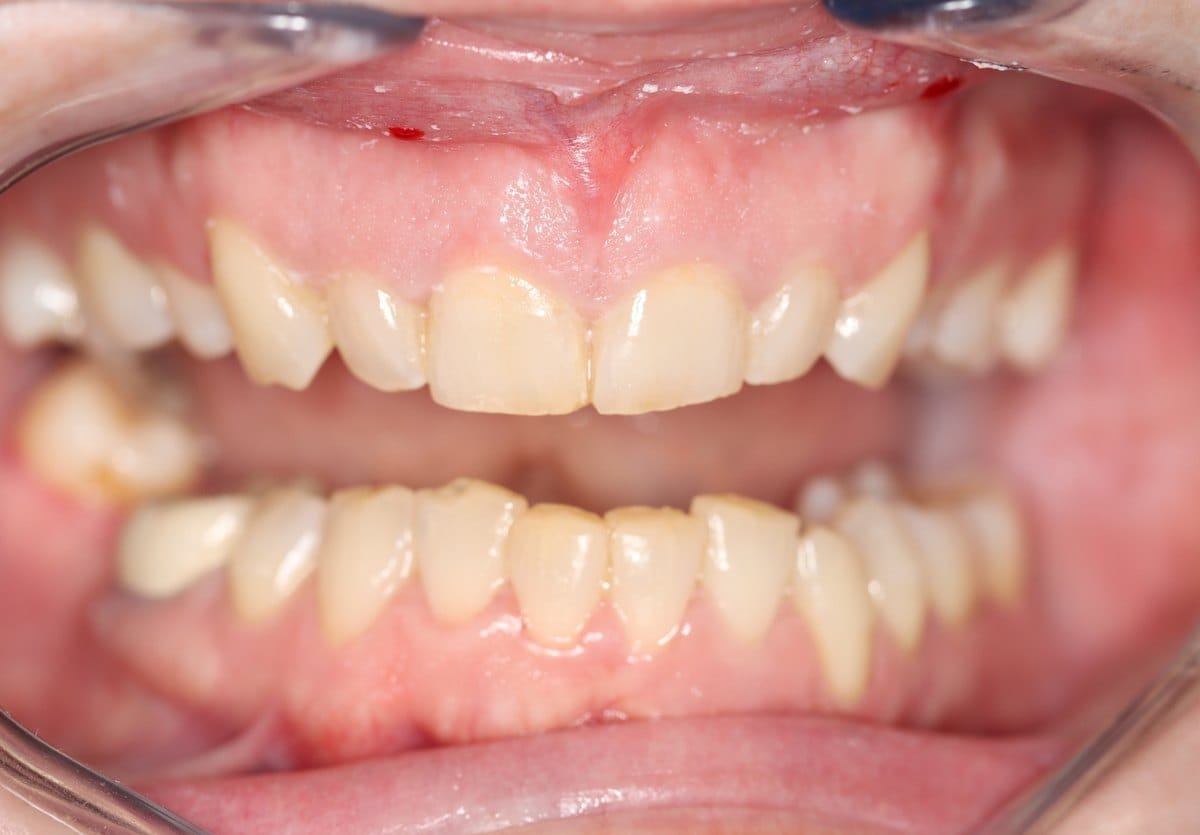
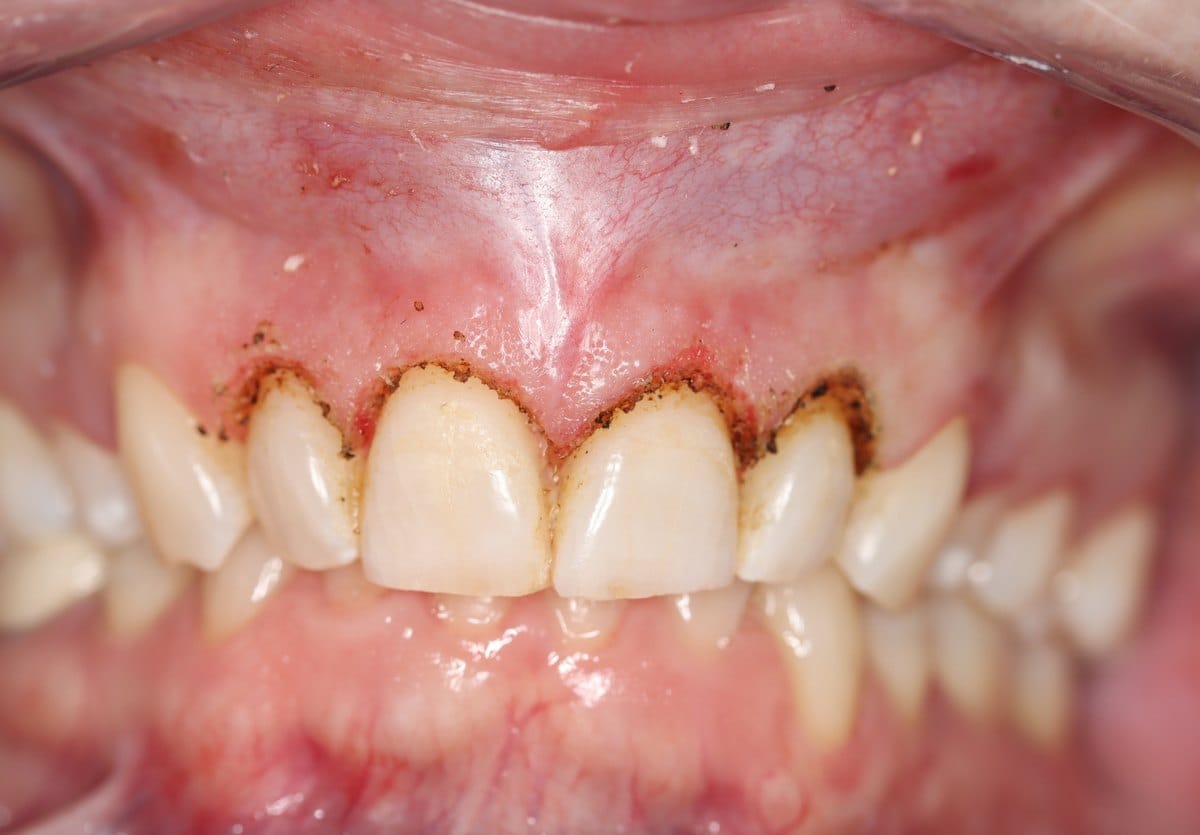
The patient wanted a brighter, more even smile. The front teeth looked short and squat — not because they were small, but because gum tissue sat too low and unevenly over them. The teeth themselves were worn, darkened and meeting edge to edge. Crowns alone would have locked a crooked gum line in permanently.
What is a gingivectomy?
A gingivectomy removes and reshapes excess gum tissue to expose more of the natural tooth and create an even, symmetrical gum line. It treats soft tissue only — the bone is not touched. Patients know it as gum contouring, gum reshaping or a gum lift.
What it is not: it does not lengthen the tooth, straighten teeth, or change its colour. It changes the frame around the tooth — and the eye reads a smile partly by where that frame sits.
When is a gingivectomy recommended?
- A gummy smile — more gum shows than the patient is comfortable with.
- An uneven gum line — teeth look mismatched even when they are the same size.
- Teeth that look short — a normal tooth partly hidden under tissue.
- Overgrown gum tissue — sometimes linked to certain medicines or long-standing inflammation.
- Before restorative work — to set the final gum position before crowns or veneers are designed, as here.
Signs of overgrowth: gums that look puffy or rolled rather than firm, a margin hiding part of the tooth, tissue that bleeds easily. The cause — eruption pattern, inherited gum and lip shape, plaque-driven inflammation, or a medication side effect — changes the approach.
Gingivectomy, gum contouring or crown lengthening?
These terms are used interchangeably online but are not the same procedure. The deciding factor is the supracrestal tissue attachment — the band of gum attaching above the bone, older texts call it biologic width. Guidance is to keep roughly 3 mm between a restoration margin and the bone (National Library of Medicine). Invade it and you get lasting inflammation and a receding gum line.
| Procedure | What is removed | When it is right |
|---|---|---|
| Gingivectomy / gum contouring | Soft gum tissue only | Enough distance to bone once the new margin is set. |
| Surgical crown lengthening | Gum tissue and a little bone | Bone sits too close to the intended margin. |
| Gum treatment (non-surgical) | Nothing — plaque and tartar only, with pocket reduction where gum disease is present | The gum looks enlarged because it is inflamed. Treat the gum disease first, then reassess. |
That last row matters: swollen gums mimic excess gums. This patient had a hygiene visit the week before surgery, so we reshaped healthy tissue rather than inflammation that would have settled anyway. Where inflammation is the whole problem the route is different again — here is how gum treatment compares with a deep clean.
Is a laser or a scalpel better for a gingivectomy?
Both are recognised. A scalpel gives a precise margin and remains conventional; a laser seals small vessels as it works, so there is very little bleeding and the field stays clear enough to judge the contour as it is cut.
This case was done with a laser, for that reason — restorative work was planned close behind, so a clean margin with minimal bleeding mattered. Some reviews do report more soft-tissue rebound after laser techniques, which is why the healed contour is reviewed rather than assumed. We pick the instrument that suits the tissue and the plan.
How is a gingivectomy done?
- Planning. The new gum line is marked tooth by tooth and measured against the neighbours so the finished margins are symmetrical.
- Local anaesthetic. The area is fully numbed. For a few teeth the appointment takes well under an hour.
- Reshaping. Excess tissue is removed along the marked contour and scalloped to follow each tooth’s natural curve.
- Review. Symmetry is checked with the lip in a normal smiling position, not with the mouth held open.
What is recovery after a gingivectomy like?
Under local anaesthetic the procedure itself is not felt, though the injection is, and there is soreness once the numbness wears off. Published guidance describes mild to moderate short-term discomfort rather than severe pain, with most people back to normal within a day or two (Cleveland Clinic).
| Stage | Timing | What you notice |
|---|---|---|
| Straight after | Day 0 | Numbness, then tenderness. Soft foods. |
| Surface healing | About 1–2 weeks | Soreness and sensitivity settle. |
| Tissue settles | About 3–5 weeks | Contour stabilises; final gum position can be judged. |
Aftercare: soft foods for about a week, gentle brushing away from the margin, and any rinse we prescribe. Call us for fever, bleeding that will not stop, or uncontrolled pain. Removed tissue does not regrow, though a small rebound can occur as the margin remodels; relapse risk rises with plaque, smoking and ongoing inflammation, so excellent home care is what holds the result.
Wondering whether your gum line is why your teeth look short? One consultation with photographs and radiographs will tell you. See our full range of dental treatments, or browse treatments and service areas or call 071 884 3204.
Why did the gums have to come before the crowns?
A crown is made to a margin, designed in a specific relationship to the gum. If the gum line is in the wrong place when the crown is designed, the crown is built to a flawed reference — and once bonded, that flaw is permanent. You cannot fix it afterwards without remaking the crown.
So the order is not preference. Correct the frame, let it settle, build to it. This patient’s gum reshaping was done at its own separate appointment, ahead of any crown work.
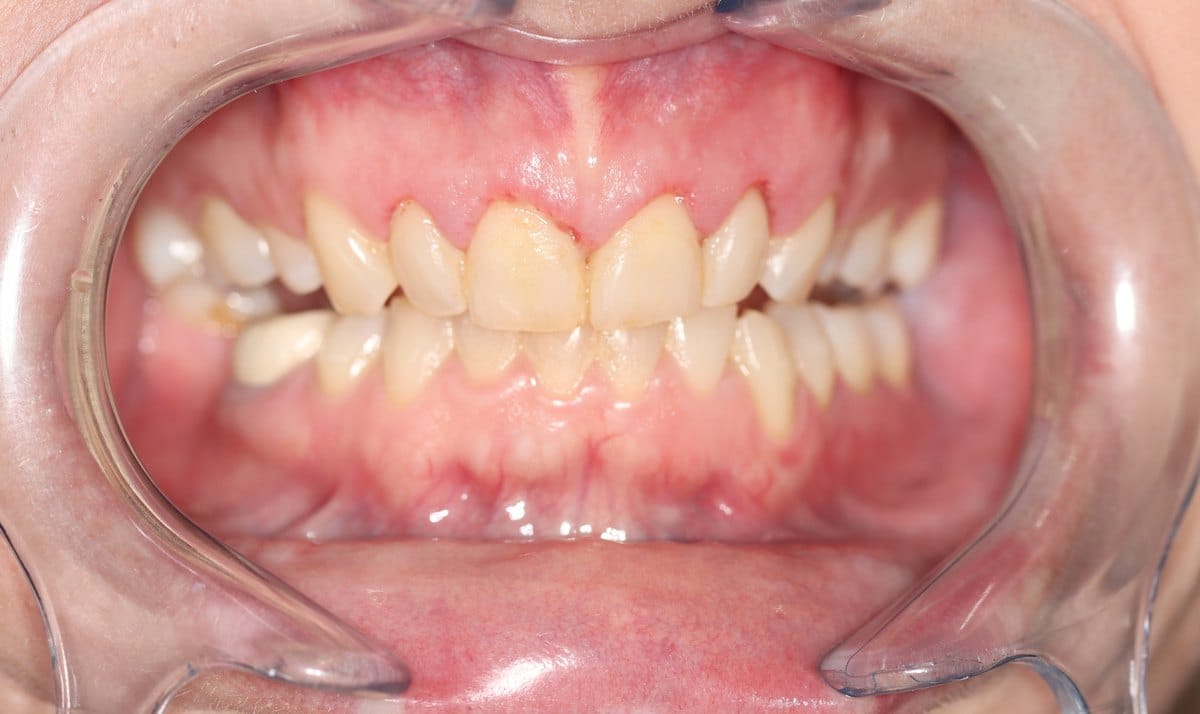
What is a smile makeover?
A smile makeover is a plan, not a single treatment. For one person that is gum reshaping and two composite veneers; for another, a full-arch restoration. What they share is that health comes before appearance — decay, gum disease and a failing bite come first, because an attractive restoration on an unhealthy foundation does not last.
Planning runs: assessment with radiographs and, where needed, a 3D scan (this case had a cone-beam scan); photographs at every stage; hygiene and repair work; digital design of shape, length, shade and gum position agreed with you; then sequenced treatment and review.
| Treatment | What it addresses | Investment |
|---|---|---|
| Hygiene and gum therapy | Inflammation, staining, gum health | $ |
| Gingivectomy / gum contouring | Gummy or uneven gum line | $$ |
| Composite bonding and veneers | Chips, small gaps, minor shape changes | $$ |
| Clear aligners | Crowding and alignment before cosmetic work | $$$ |
| Porcelain veneers | Shape, shade and surface of front teeth | $$$ |
| Ceramic crowns | Heavily worn, broken or restored teeth | $$$ |
| Full-arch restoration | Widespread wear affecting the whole bite | $$$$ |
Veneers are a thin facing for a sound tooth of the wrong shape or shade. A crown covers the whole tooth and suits one that is worn, broken or heavily restored. This patient’s teeth were worn throughout, so veneers alone would not have solved it. See our comparison of veneers versus crowns and which lasts longer.
Why restore one arch at a time?
The restorative work ran over two consecutive days — upper arch first, lower the next. Restoring one arch first lets us establish the vertical dimension of the bite, the incisal edge position and the front guidance, and confirm the patient tolerates that new jaw relationship before the opposing arch is shaped to meet it.
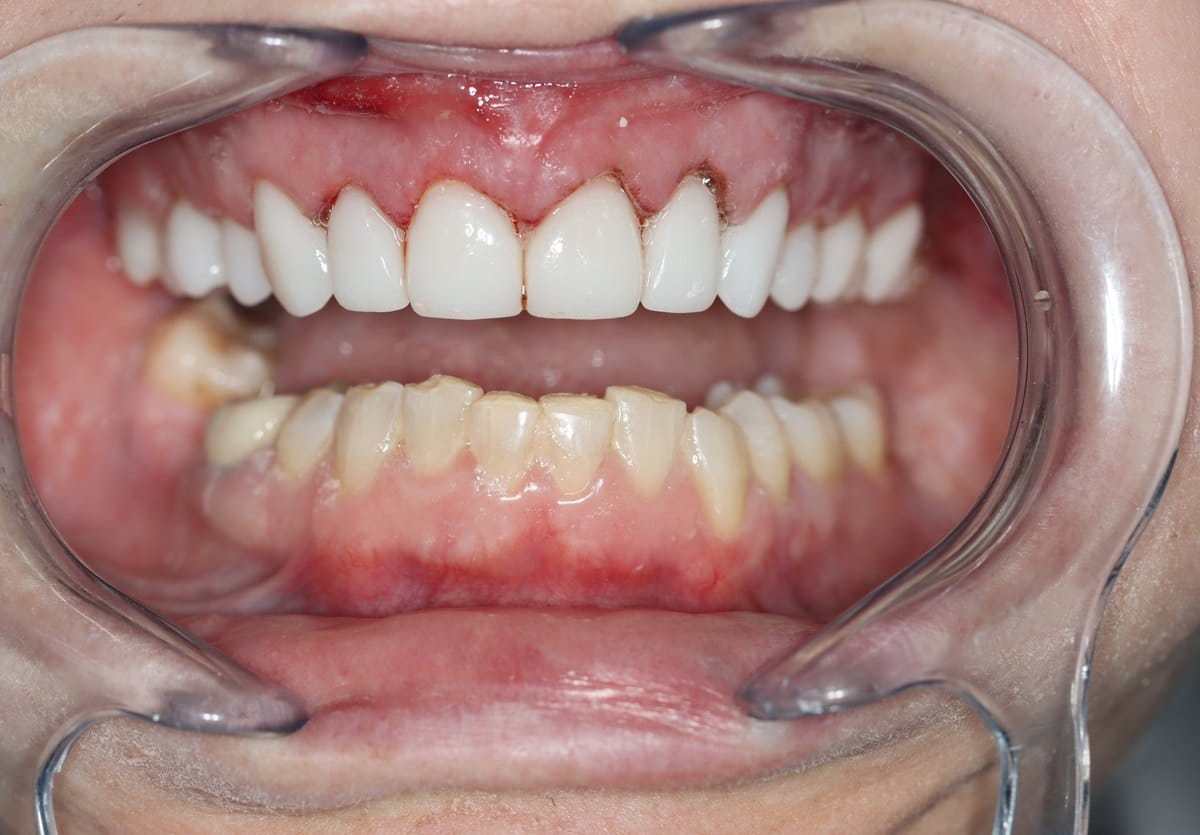
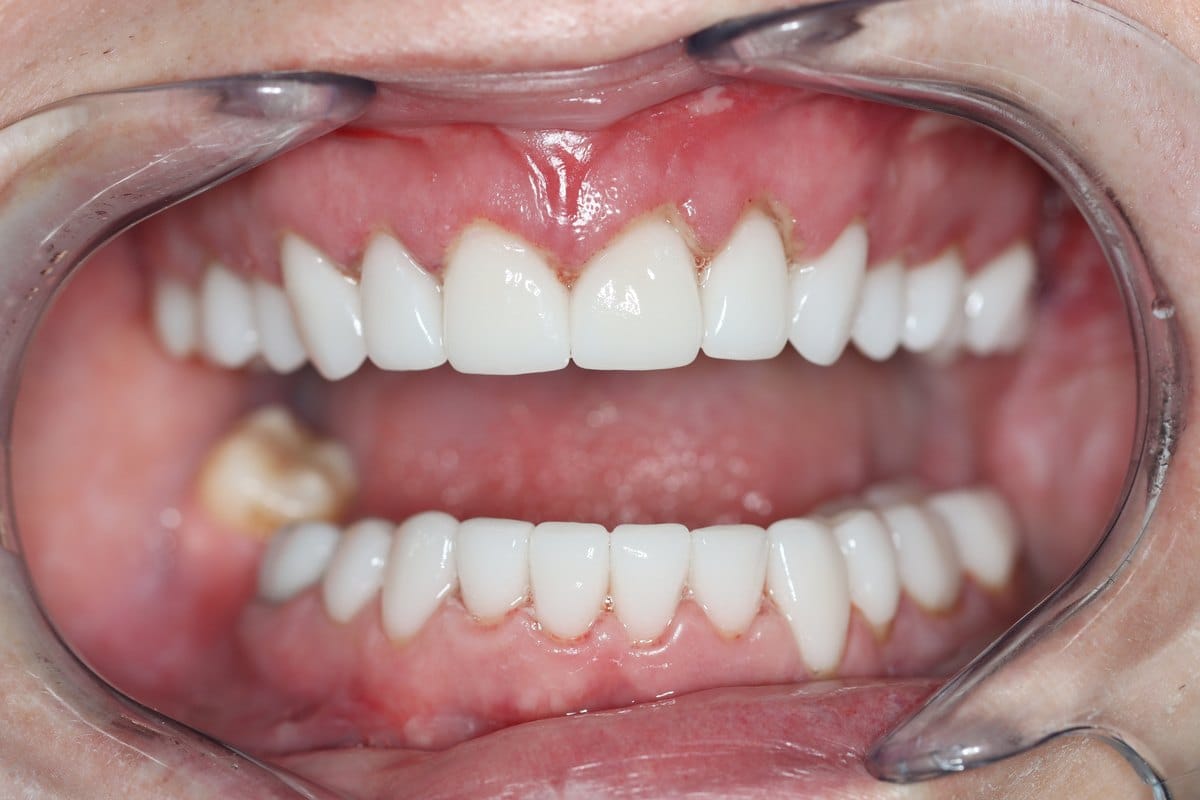
The crowns were milled from lithium disilicate, a pressed ceramic chosen for its strength and the way it handles light — which is what makes a crown read as a tooth rather than a block of white. Published five-year survival for these crowns sits around 95–98%, commonly beyond ten years, though results vary by case and technique (National Library of Medicine).
How is the result protected afterwards?
A night guard and a retainer were made afterwards. Where teeth have worn down, something caused that wear — often clenching or grinding. Ceramic is strong but brittle, and heavy night-time load is what chips it. A guard puts a removable layer between the arches so the force lands there. Stated plainly: a guard does not cure grinding, but it is the accepted way to protect a rehabilitation from it.
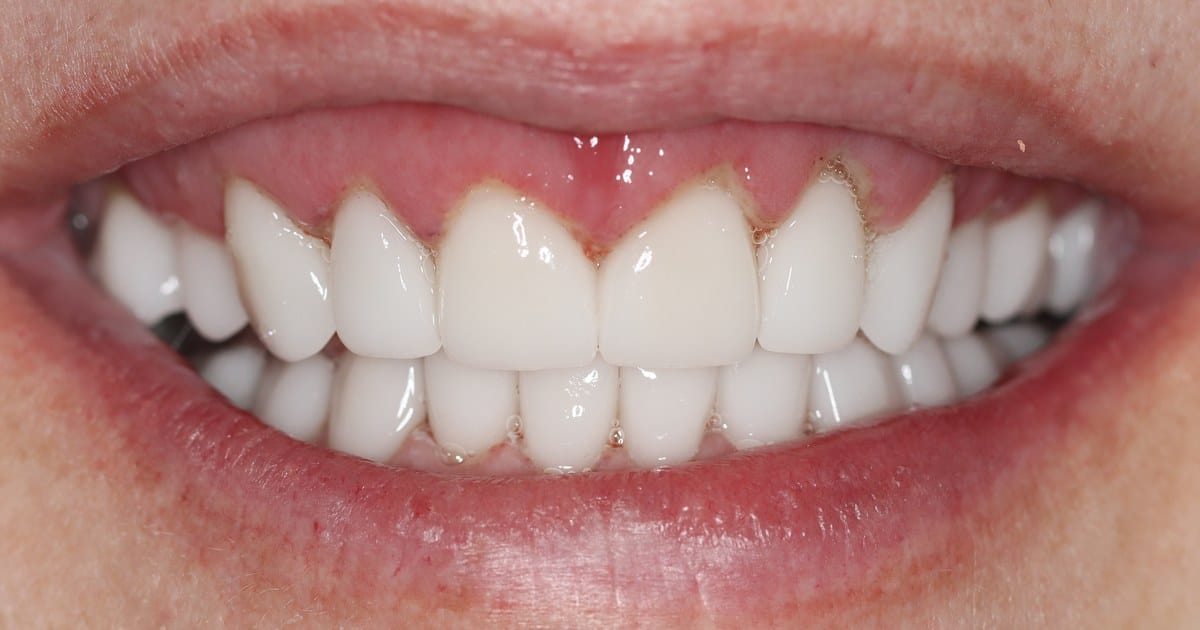
Why the gums still look pink in the final photographs
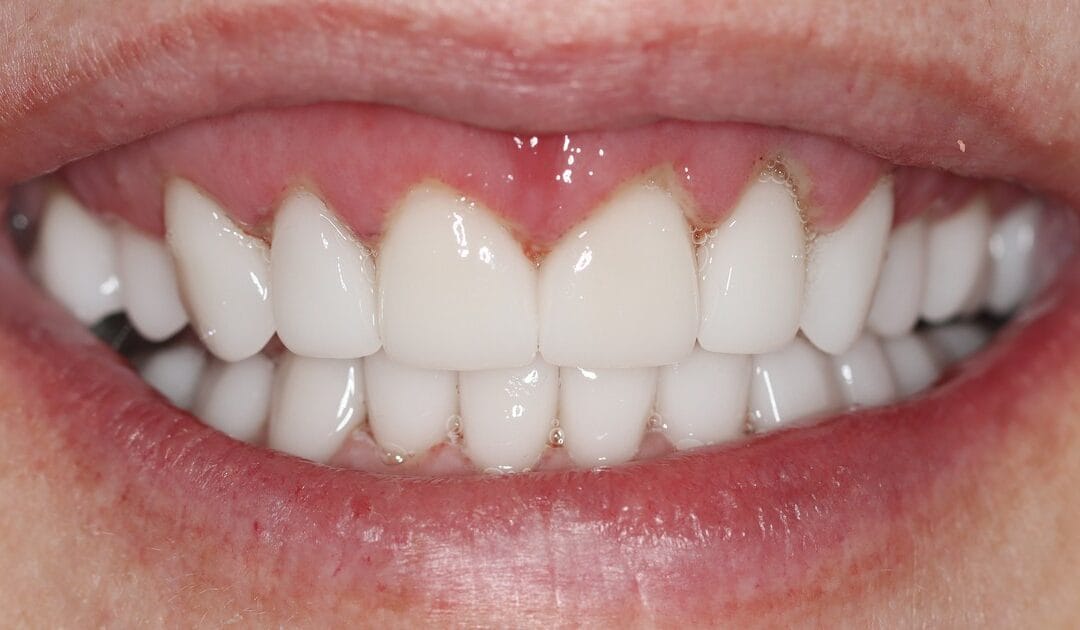
Worth saying plainly, because it is visible above: every one of these photographs was taken within days of treatment, not months later. The margins are still healing — fuller and pinker than they will settle to. Surface healing runs one to two weeks and the contour settles over roughly three to five, so this is the finished result a few days in, not the finished result. Gum tissue recovers faster than most patients expect, which is why we have shown this stage rather than waiting for the flattering version.
At a follow-up call days later, the patient reported being happy with the result and committed to six-monthly check-ups.
Is this case finished? Not quite
This case still has work outstanding. One back tooth on the lower arch could not be saved and needs to come out. That extraction is not being done in-house — the patient has been referred to a specialist, and the space will be reassessed once the site heals. Two lower teeth were left uncrowned, because they did not need it.
That is a normal, well-run case. A smile makeover is a programme of care that unfolds over months, not a transaction that ends when the photographs look good.
Why do we refer to specialists?
General and cosmetic dentistry covers a great deal, but not everything, and knowing where your scope ends is part of the job.
| Specialist | What we refer for |
|---|---|
| Oral and maxillofacial surgeon | Difficult or surgical extractions, impacted teeth, bone grafting, jaw surgery — the referral made in this case. |
| Periodontist | Advanced gum disease, and gum surgery involving bone rather than soft tissue alone. |
| Endodontist | Complex or repeat root canal treatment, and unusual root anatomy. |
| Prosthodontist | The most complex full-mouth reconstructions and difficult bite problems. |
| Dental laboratory technician | Custom ceramic work, night guards and retainers, made to our design. |
Even in-house this is not a one-person job: two of our dentists worked on the case, alongside hygiene and laboratory work. When we refer, we stay involved — we send the records and radiographs, agree the plan with the specialist, and keep the sequence on track. You are not handed a phone number and left to organise it.
What affects the cost?
We do not quote figures online, because a smile makeover is not one product. What drives the number: how many teeth are involved, the materials, whether preparatory treatment or a specialist referral is needed, whether the bite is being rebuilt, and protective extras like guards and retainers. Broadly: hygiene at $, gum contouring and composite work at $$, veneers, aligners and individual crowns at $$$, full-arch rehabilitation at $$$$. See our guide to what a smile makeover costs in Roodepoort.
You receive an exact, personalised estimate in writing after your consultation, before treatment begins.
Frequently asked questions
What is a gingivectomy?
It removes and reshapes excess gum tissue to expose more of the natural tooth and create an even gum line. Soft tissue only — no bone is involved.
Does gingivectomy hurt?
It is done under local anaesthetic, so it is not felt at the time. Most patients report mild to moderate soreness afterwards, settling over a few days.
How long does recovery take after gingivectomy?
Surface healing takes one to two weeks, with most people back to their routine in a day or two. The contour settles fully over about three to five weeks.
How much does gingivectomy cost?
It depends on how many teeth are treated and what else is done at the same time. Gum contouring sits in the $$ band on our scale, and you receive a written estimate after your consultation.
Is gingivectomy covered by dental insurance or medical aid?
Cover differs by plan and depends on whether the procedure is clinically indicated rather than purely cosmetic. We give you the procedure codes so you can confirm your benefits with your provider before you commit.
Can teeth whitening be part of a smile makeover?
Bleaching works on natural enamel and does not change ceramic or porcelain, so the target shade is agreed before restorations are made. Once fitted, a crown’s shade is fixed.
Are smile makeover results permanent?
Long-lasting rather than permanent. Published five-year survival for these crowns sits around 95–98%, commonly beyond ten years, though outcomes vary with bite and maintenance.
Will my whole smile makeover be done at one practice?
Most of it, yes. Where a case needs a specialist — a surgical extraction, advanced gum surgery or complex root treatment — we refer, send the records and radiographs, and keep the overall plan on track.
What happens if a tooth cannot be saved during a smile makeover?
If it needs to come out, we refer you for the extraction, let the site heal, then reassess how best to fill the space. That step sits outside the cosmetic sequence and does not hold up the rest of the plan.
Where can I book a smile makeover consultation in Roodepoort?
Our practice is in Amorosa, Roodepoort, and we see cosmetic patients from across the West Rand and greater Johannesburg. Call 071 884 3204 or message us on WhatsApp on 083 710 9131.
Why choose us for gum contouring and smile makeovers?
Our team’s experience in cosmetic dentistry is to assess before we treat, photograph every stage, and sequence soft tissue before restorative work so the result is designed to a corrected gum line. You get a written plan and estimate before anything starts, and our team walks you through each page.
Book a smile makeover consultation in Roodepoort
If your teeth look short, your gum line is uneven, or wear has shortened your smile, start with a proper assessment — not a quote over the phone. We examine, photograph and radiograph, explain what is realistic, and give you a written plan and estimate before anything starts.
We are in Amorosa, Roodepoort, serving the West Rand and greater Johannesburg. Call 071 884 3204 or WhatsApp 083 710 9131. Bookings can be made at any hour of the day; we treat patients Monday to Friday, 08:00–17:00.
Written by Dr Chalita le Roux, BChD cum laude (UP 2020), HPCSA DP 0118702, SAAAD member.
Last verified: August 2026. This article is for general information and is not clinical advice. Individual results vary with your own dental health, bite and maintenance. The clinical photographs show one patient’s treatment and do not represent what any other patient will achieve. Always seek an in-person assessment from a registered dental practitioner before making treatment decisions. Professional standards per the Health Professions Council of South Africa and the South African Dental Association.