
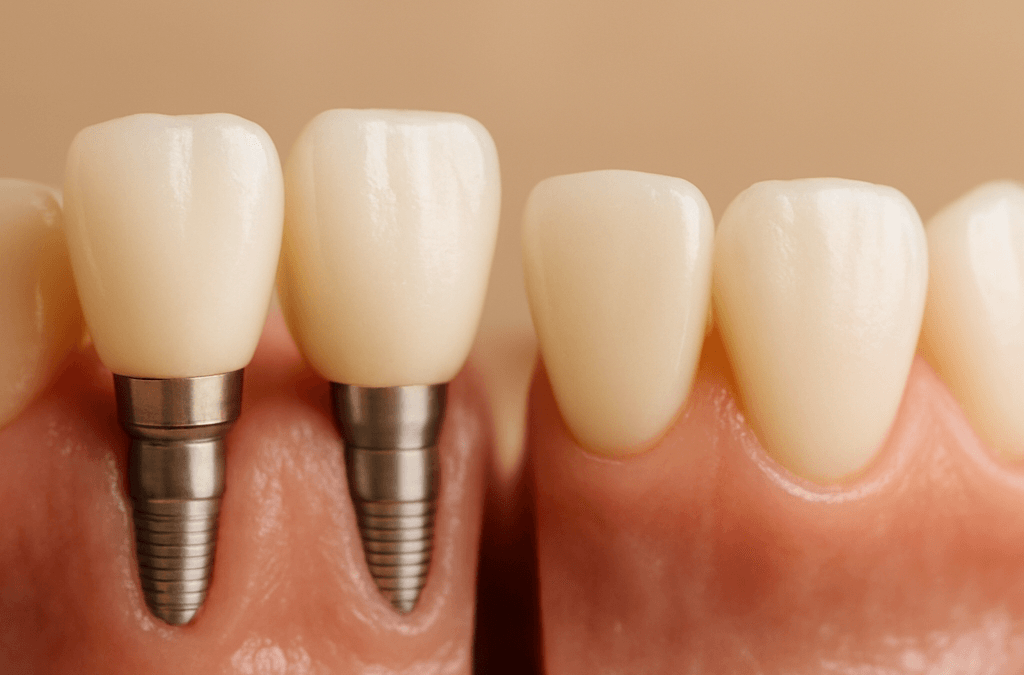
Implant or bridge: which is the better way to replace your missing tooth, and what does each one ask of the teeth around it?
In this article:
- What’s the difference between a dental implant and a bridge?
- What are the pros and cons of each option?
- How do implants and bridges affect your oral health?
- Which option lasts longer and how do you care for it?
- What does treatment involve and how long does it take?
- How do implant and bridge costs compare over time?
- Who may be a good candidate for each treatment?
- Where can you compare your options with a local dentist?
What’s the difference between a dental implant and a bridge?
A dental implant replaces a missing tooth from its root upwards. A small titanium post is placed in the jawbone, where it can bond with the bone as it heals. Once the site is ready, a connector and a crown are attached to create a tooth-shaped replacement. An implant does not rely on the teeth beside the gap for support, but it does require enough suitable bone and healthy tissues for treatment.A bridge replaces the visible tooth by joining a replacement tooth, called a pontic, to crowns on the neighbouring teeth. Those supporting teeth are shaped to make room for the crowns, so a bridge may be a practical option when they already need crowns or when implant surgery is unsuitable. A bridge does not replace the missing root, and the gap beneath the pontic needs careful cleaning.Both options can restore chewing and appearance, but they differ in preparation, healing time and maintenance. A dentist needs to examine the gap, the adjacent teeth, your bite and your general oral health before recommending either. Some people may also consider a removable denture. At Dr Chalita le Roux Inc. in Roodepoort, a consultation can help compare suitable options and plan treatment around your needs.What are the pros and cons of each option?
An implant stands independently, so the adjacent teeth usually do not need to be reshaped to support it. It can feel stable when chewing, and the crown is cleaned much like a natural tooth. However, implant treatment involves surgery and a healing period. It may take several months, and insufficient bone, active gum disease, smoking or certain health conditions can affect suitability or healing. An implant also needs ongoing professional review and can develop complications, including inflammation around the implant.A bridge can often be completed sooner because it does not depend on a post bonding with the jawbone. It may suit a gap beside teeth that already need crowns, or someone who is not a candidate for implant surgery. Its drawbacks include reshaping the supporting teeth, which may otherwise be healthy, and the need to clean under the replacement tooth. If a supporting tooth develops decay or gum problems, the bridge may be affected too.Neither option suits every gap. The number and position of missing teeth, the condition of neighbouring teeth and gums, bite forces, health history and budget all matter. A consultation can clarify the trade-offs, including whether a removable denture is worth discussing. Treatment should be planned on the basis of an examination rather than choosing by appearance or advertised lifespan alone.Not sure which option fits your gap? You can WhatsApp the practice on 083 710 9131 or call 071 884 3204 and an examination will give you a specific answer rather than a general one.
How do implants and bridges affect your oral health?
A missing tooth can leave neighbouring teeth more exposed to food trapping and may allow teeth to drift into the gap over time. Replacing it can restore contact for chewing, but the replacement still needs careful cleaning and regular dental checks.An implant transfers chewing forces to the jawbone through its post. It does not require crowns on adjacent teeth, which can preserve their natural structure. The gum around the implant must be kept clean: plaque can inflame the tissue, and ongoing inflammation may damage the supporting bone. An implant crown can also chip or loosen, so report changes such as discomfort, bleeding or movement to a dentist.A bridge relies on the teeth on either side of the gap. Preparing these teeth for crowns removes some tooth structure, and the edges around the crowns need thorough brushing. Food and plaque can collect beneath the pontic, where a toothbrush alone may not reach; floss threaders or other cleaning aids can help, with guidance from your dental team. Decay or gum disease affecting a supporting tooth can compromise the bridge.The impact on oral health depends on your starting point and daily care. Healthy gums, good cleaning habits and routine reviews matter for either option. A dentist can assess your bite, gum health and neighbouring teeth and explain the cleaning method suited to your restoration.Which option lasts longer and how do you care for it?
Implants and bridges can both serve for many years, but neither has a fixed lifespan. Research often reports implants lasting longer on average than tooth-supported bridges, though outcomes vary with oral hygiene, gum health, bite forces, smoking, general health and maintenance. An implant post may remain stable while its crown needs repair or replacement; a bridge can also need repair or replacement if its crowns, supporting teeth or gums develop problems.Care for an implant crown much like a natural tooth: brush twice daily with fluoride toothpaste, clean between teeth and around the gumline, and attend regular dental reviews. The implant itself cannot decay, but the surrounding gum and bone can be affected by plaque. Avoid using teeth to open packaging, and ask your dentist about a night guard if grinding is a concern.With a bridge, brush carefully around the crowns and clean beneath the pontic every day using a floss threader, interdental brush or another suitable aid. Your dentist or hygienist can show you how to do this without injuring the gum. For either restoration, seek advice if you notice persistent bleeding, pain, looseness, a change in your bite or damage to the crown. Regular checks allow problems to be assessed before they become more difficult to manage.What does treatment involve and how long does it take?
Treatment starts with an assessment of the gap, neighbouring teeth, gums and bite, along with your medical and dental history. X-rays or other imaging may be needed to check bone and plan an implant. The dentist will explain whether an implant, bridge or another option is appropriate and discuss the stages, likely timing and maintenance.For an implant, the post is placed in the jawbone during a procedure under local anaesthetic, with sedation options discussed where appropriate. The gum and bone then need time to heal and bond with the implant. This can take several months; the timing depends on the site and whether additional procedures, such as bone grafting, are needed. A temporary tooth may be considered during healing, depending on the clinical plan. Once the site is ready, the final crown is fitted.A bridge usually takes less time overall because it does not require bone integration. The supporting teeth are prepared, impressions or digital scans are taken, and a temporary bridge may be placed while the final restoration is made. The finished bridge is then checked and fitted. The number of visits and timeframe depend on the case and laboratory or restorative steps. Dr Chalita le Roux Inc. offers CEREC same-day crowns, but suitability and availability for a particular restoration need to be confirmed at consultation.How do implant and bridge costs compare over time?
An implant often has a higher initial cost than a bridge because treatment includes planning, surgery, the implant components and a crown. Additional procedures, such as bone grafting, can affect the overall fee and timeline. A bridge may cost less at the outset, although the number of supporting teeth and the materials used influence its price.It can help to compare the full treatment plan rather than a single starting fee. Ask what is included, whether temporary restorations or imaging are needed, and what follow-up care is expected. Over time, either restoration may need maintenance or replacement. A bridge can be affected by decay or gum disease in its supporting teeth; an implant crown may need repair even if the post remains in place. These possibilities are not certain, and individual outcomes differ.For a broad budgeting guide, people sometimes use relative tiers: bridge treatment may fall around $$–$$$, while implant treatment may fall around $$$–$$$$. These are general comparisons, not quotes; the clinical plan and practice fees determine the actual cost. If you belong to a medical scheme, Dr Chalita le Roux Inc. provides a detailed practice statement which you submit to your scheme for reimbursement directly. Confirm your benefits with the scheme before treatment.Who may be a good candidate for each treatment?
An implant may be considered when one or more teeth are missing, the jawbone has suitable volume and quality, and the gums and general health allow surgery and healing. A dentist will review factors such as gum disease, smoking, some medical conditions and medicines, as these can affect healing or long-term maintenance. Bone grafting may be discussed if there is not enough bone, but it adds treatment steps and is not suitable for everyone.A bridge may be worth considering when the teeth beside the gap are strong enough to support it, particularly if they already need crowns. It can also be an option for someone who prefers to avoid implant surgery or whose health or bone conditions make an implant unsuitable. Because bridge preparation involves reshaping supporting teeth, it may be less appealing when those teeth are healthy and intact.The size and location of the gap matter. Replacing several teeth, managing a changing bite or treating active decay and gum disease may require a broader plan before a fixed replacement is placed. A removable denture may be another option in some cases. The dentist can examine your mouth, discuss your health history and explain the expected benefits, limitations and upkeep of each approach. Suitability is individual, so an online comparison cannot replace a clinical assessment.Where can you compare your options with a local dentist?
To compare an implant and a bridge in person, you can book a consultation with Dr Chalita le Roux Inc. at Unit 2, Amorosa Office Park, Corner of Doreen Road and Lawrence Road, Amorosa, Roodepoort, 2040. Dr Chalita le Roux holds BChD cum laude (UP 2020), is registered with the HPCSA as DP 0118702, and is a SAAAD member.At a consultation, the dentist can examine the gap and supporting teeth, assess your gums and bite, review your health history, and explain whether imaging is needed. You can discuss treatment stages, cleaning, possible risks, likely timing and costs before deciding. The practice offers general dentistry, dental implants including All-on-4, and sedation dentistry; the appropriate service depends on the clinical assessment.The practice is open Monday to Friday, 08:00 to 17:00, and is closed on weekends and South African public holidays. English and Afrikaans are spoken, and free on-site parking is available. To enquire, call 071 884 3204 or 011 568 8285. The map is at https://maps.app.goo.gl/3iHKg7AMa8qRcfLf6.How the implant-or-bridge decision is made here
The choice rests on three things seen at the examination: the condition of the teeth either side of the gap, the bone where the tooth used to be, and how long you want the solution to last. A bridge uses the neighbouring teeth for support, so if they are already crowned or heavily filled it can be the natural choice; an implant leaves them untouched. Both are discussed with the imaging in front of you, and the recommendation goes into a written plan you can take home and think over.
Dr Chalita le Roux is BChD cum laude (University of Pretoria, 2020), HPCSA-registered (DP 0118702), and a member of the South African Academy of Aesthetic Dentistry. The practice is in Amorosa, Roodepoort, with free on-site parking.
Frequently asked questions
Is a dental implant better than a bridge?
Neither option is automatically better for everyone. An implant replaces the tooth root and supports a crown without using neighbouring teeth, but it involves surgery and healing time. A bridge can be completed sooner and may suit teeth that already need crowns, but it requires reshaping the supporting teeth and careful cleaning beneath the replacement tooth. The choice depends on your gums, bone, adjacent teeth, health, bite and preferences. A dentist can assess these factors and compare the treatment plans with you.Which lasts longer: a dental implant or a bridge?
Implants often last longer on average than tooth-supported bridges, but there is no fixed lifespan for either. An implant post may remain in place while its crown eventually needs repair or replacement. A bridge can be affected by decay, gum disease or damage involving its supporting teeth. Daily cleaning, regular dental reviews, bite forces, smoking and general health all influence outcomes. Ask your dentist what maintenance your proposed restoration will need and what signs should prompt a review.Is a bridge cheaper than a dental implant?
A bridge often has a lower initial cost because it does not include implant surgery and the associated components. An implant plan can cost more, particularly if additional procedures are needed. The exact fees depend on the number of teeth, materials and clinical steps. Over time, either restoration may need maintenance or replacement, so compare the full plan rather than just the initial fee. If you belong to a medical scheme, ask about your benefits; the practice provides a detailed statement for you to submit for reimbursement directly.What are the disadvantages of a dental bridge?
A conventional bridge usually requires shaping the teeth on either side of the gap to support crowns, which removes some natural tooth structure. Plaque and food can collect beneath the replacement tooth, so cleaning there needs extra care with a floss threader or another suitable aid. The bridge also depends on its supporting teeth: decay or gum problems in those teeth can affect the restoration. A dentist can assess whether the adjacent teeth are suitable and show you how to maintain a bridge.Do dental implants damage adjacent teeth?
An implant is placed in the jawbone at the missing tooth site and does not usually require shaping the neighbouring teeth to hold a crown. That is one difference from a conventional bridge. As with any surgery, planning and placement need care, and your dentist will assess the gap, bone and nearby structures beforehand. Implants can also develop gum inflammation if plaque is not controlled. Good home cleaning and routine dental reviews help monitor the implant and surrounding teeth.How long does a dental implant take compared with a bridge?
A bridge is often completed sooner because it does not need time for an implant post to bond with the jawbone. It generally involves preparing the supporting teeth, making the restoration and fitting it, with the number of visits depending on the case. Implant treatment includes surgery followed by healing, which can take several months before the final crown is fitted. Bone grafting or other clinical needs may add time. Your dentist can estimate the sequence after examining the site.Can you get an implant instead of a bridge?
Often, an implant can be considered as an alternative to a bridge for replacing a missing tooth, but suitability depends on the amount and condition of jawbone, gum health, general health and the position of the gap. An implant avoids using the adjacent teeth for support, but requires surgery and healing time. If bone is limited or other health factors apply, a bridge or another option may be more appropriate. A clinical examination and, where needed, imaging can guide the decision.Which option is right for replacing one missing tooth?
For one missing tooth, an implant with a crown and a bridge supported by neighbouring teeth are both possible options. An implant may suit someone with adequate bone and healthy gums who wants to avoid preparing adjacent teeth. A bridge may suit someone whose neighbouring teeth already need crowns or who is not a suitable implant candidate. Your bite, health, cleaning habits, treatment timeline and budget also matter. A dentist can assess the area and explain the trade-offs before you choose.Book a consultation about replacing a missing tooth
If you have a gap to fill and want a straight answer on implant versus bridge, you can WhatsApp the practice on 083 710 9131, call 071 884 3204, or email info@drchalitaleroux.co.za. We respond within two business days, Monday to Friday 08:00 to 17:00.
Related reading on our site: Dental implants compared with a bridge · Dental bridges · Dental implants
Last verified: October 2026. This article is general information for patients and is not clinical advice; it does not replace an examination of your own teeth. Written by Dr Chalita le Roux, BChD cum laude (University of Pretoria, 2020), HPCSA DP 0118702, member of the South African Academy of Aesthetic Dentistry.