
A dental crown, often called a cap, is a custom-made cover that fits over the whole visible part of a tooth to protect it and restore its shape, strength and appearance. You may need one when a tooth is cracked, badly broken, heavily filled or weakened after root canal treatment. At Dr Chalita le Roux Inc in Roodepoort, many metal-free ceramic crowns can be designed, milled and fitted in a single visit with CEREC same-day technology, where the tooth and case are suitable.
Looking for veneers? See porcelain veneers or composite bonding.
- A crown covers the whole tooth; a filling, onlay or veneer covers only part of it.
- Crowns suit cracked, broken, heavily filled or root-treated teeth that need protection.
- Same-day CEREC ceramic crowns are possible in many suitable cases; some cases need a dental laboratory.
- With good care, crowns often last many years, but they can chip, loosen or need replacing.
- You receive a written estimate after your consultation, before any treatment starts.
What is a dental crown, and who does it suit?
A crown is a tooth-shaped restoration that is bonded or cemented over a prepared tooth. It holds the remaining tooth together and takes the biting load, so it is used when a tooth has lost too much structure for a filling to be reliable.
A crown often suits you if you have:
- a cracked or broken tooth, or a tooth with large old fillings that keep breaking;
- a back tooth that has had root canal treatment and lost a lot of tooth structure, so it needs protection from chewing forces;
- a tooth worn down by grinding, or badly decayed with little sound tooth left;
- a front tooth that is badly discoloured or misshapen where whitening, bonding or a veneer is not suitable;
- a missing tooth that will be replaced with a dental implant or a bridge, which both use crowns.
A crown is not the first choice for every damaged tooth. Preparing a tooth for a crown removes more enamel than a filling, and that cannot be undone. Dr Chalita le Roux examines the tooth, takes X-rays where needed, and recommends the most conservative option that will last.
When is a filling, onlay, veneer or implant crown a better choice?
The right restoration depends on how much healthy tooth is left and what the tooth needs to do. This comparison is a general guide; your options are confirmed at your consultation.
| Option | Usually suits | Compared with a crown |
|---|---|---|
| Filling | Small to moderate decay or a minor chip, with most of the tooth intact | Keeps more natural tooth, but is less suited when a large part of the tooth is missing |
| Onlay (partial crown) | A back tooth that has lost one or more cusps but still has strong walls | Covers only the damaged part, so less tooth is reshaped |
| Veneer | Healthy front teeth that need a change in colour or shape | Covers the front surface only; it is mainly cosmetic and not designed to strengthen a weak tooth |
| Crown | A cracked, broken, heavily filled or root-treated tooth | Covers the whole visible tooth to protect and strengthen it |
| Implant crown | A missing tooth, or one that cannot be saved, where the bone and gums suit an implant | Replaces a missing tooth; the crown sits on an implant, not on your own tooth |
What types of dental crowns do we offer?
We focus on tooth-coloured, metal-free materials. The choice depends on where the tooth is, how much of it is left, your bite and how visible it is when you smile.
- All-ceramic and porcelain crowns can be shaded to match the colour and translucency of natural enamel, so they are often chosen for front teeth and visible areas.
- Zirconia and other high-strength ceramics are designed for back teeth that take heavier chewing forces, or for people with a strong bite.
- Same-day CEREC ceramic crowns are designed on screen and milled on site, which avoids a temporary crown in suitable cases.
- Laboratory-made crowns are still used for more complex cases or where extra customisation is needed.
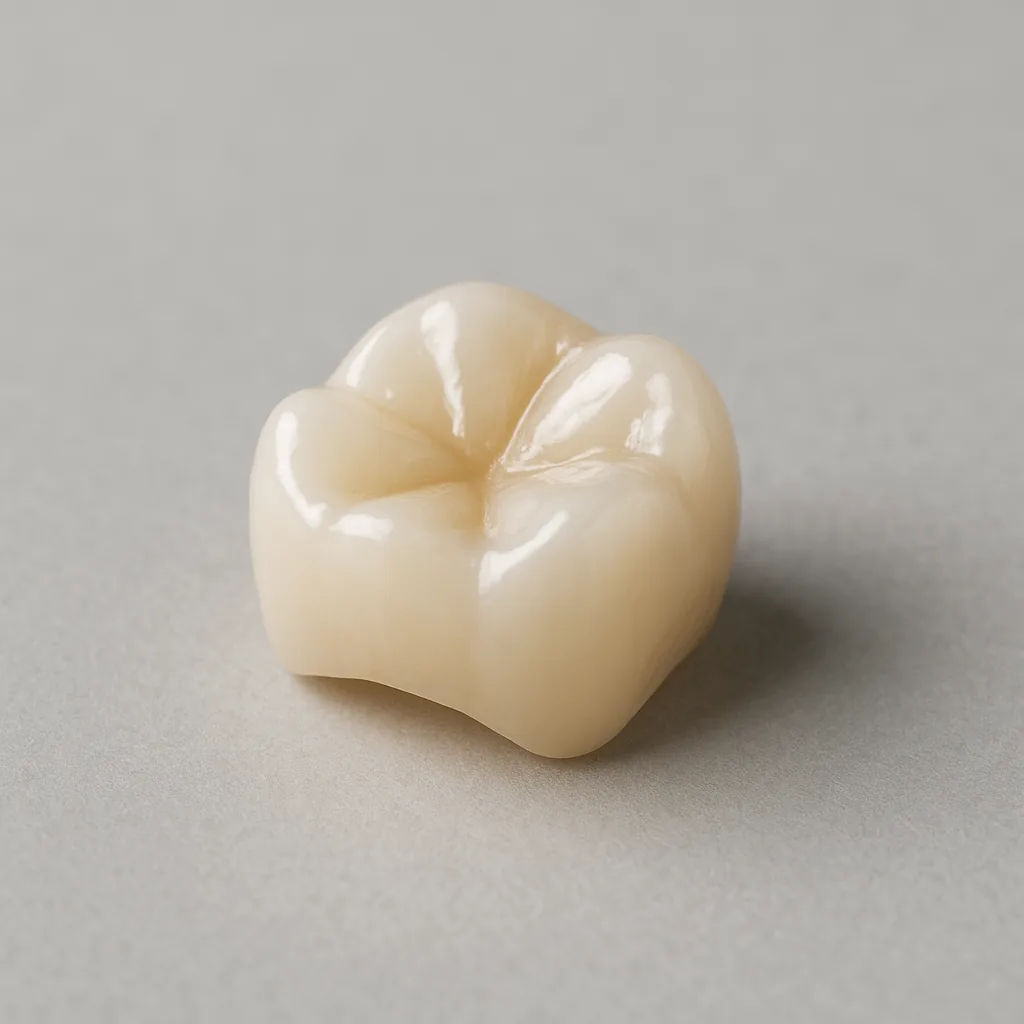
Metal-free crowns help avoid the dark line at the gum edge that some older metal-based crowns show. If you grind your teeth heavily, we explain the trade-offs between materials and may suggest a night guard.
What happens at a crown appointment, and can it be done in one day?
- Consultation and X-rays. We examine the tooth, check your bite and gums, and confirm that a crown is the right option.
- Numbing and preparation. The tooth is numbed with local anaesthetic. Weak or decayed tooth is removed and the tooth is shaped to make room for the crown. A build-up, or a post and core after root canal treatment, may be placed first.
- Digital scan. A digital scan records the prepared tooth and your bite, often instead of a traditional impression.
- Same-day or laboratory crown. With CEREC, the crown is designed and milled on site and is often fitted at the same appointment, which usually takes a few hours, including time while the crown is milled. A laboratory crown needs a temporary crown and a second visit, usually a week or two later.
- Fitting and bite check. The final crown is checked for fit, colour and bite, adjusted if needed, then bonded or cemented in place.
Same-day treatment is not suitable for every tooth. Several crowns, a complex bite or specific aesthetic needs may call for a laboratory crown. Dr Chalita confirms the plan and the number of visits after examining you.
What are the risks, and how long do crowns last?
- Sensitivity: some people notice temporary sensitivity to hot or cold after the tooth is prepared.
- Chipping or cracking: ceramic can chip, especially with grinding or biting hard objects.
- Decay at the edge: the tooth under a crown can still decay where the crown meets the tooth, so cleaning that margin matters.
- Nerve problems: a heavily restored tooth may later need root canal treatment.
- Replacement: lifespan varies with the material, your bite and your oral care. With good care, many crowns last 10 to 15 years or longer, although some need repair or replacement sooner.
To care for a crown, brush twice a day with fluoride toothpaste and clean between your teeth every day, including around the crown margin. Avoid chewing ice, pens or other hard objects. Keep up regular check-ups so we can monitor the crown and your gums. If a crown feels loose, cracks or causes ongoing pain, contact the practice for an assessment.
What affects the cost of a dental crown in Roodepoort?
We do not publish fees, because the price of a crown depends on what we find at your examination. The main factors are:
- the material, such as all-ceramic, porcelain or zirconia;
- same-day CEREC milling compared with a laboratory-made crown;
- any work needed first, such as a build-up, a post and core or root canal treatment;
- how many teeth need crowns, and whether a crown is part of a bridge or implant restoration.
We show cost on a practice-wide scale, where $ is routine care such as check-ups and simple fillings and $$$$ is major work such as full-arch implants. On that scale, a single ceramic crown on a tooth that needs no extra work usually sits at $$; a crown that needs a build-up, a post and core or detailed shade matching on a front tooth sits at $$ to $$$; and several crowns, or crowns combined with root canal, bridge or implant treatment, move into $$$ to $$$$. These tiers are relative guides, not fees. An exact estimate is given in writing after your consultation, before any treatment starts.
Frequently asked questions
How much does a dental crown cost in South Africa?
The cost depends on the crown material, whether it is a same-day CEREC or laboratory crown, any work needed first, such as a post and core or root canal treatment, and how many teeth are involved. We do not publish fees. After a consultation in Roodepoort, you receive a written treatment plan with a transparent estimate before any treatment begins.
Is a dental cap the same as a crown?
Yes. Cap is the everyday word for a dental crown. Both describe a custom-made cover that fits over the whole visible part of a tooth to protect it and restore its shape and appearance.
Can I get a crown in one day?
In many cases, yes. With CEREC same-day technology, the tooth is prepared, scanned, and the ceramic crown is designed and milled on site, so it can often be fitted in one appointment. Several crowns, a complex bite or specific aesthetic needs may call for a laboratory crown and a second visit.
Is getting a dental crown painful?
The tooth is numbed with local anaesthetic, so most people feel pressure rather than pain during preparation. Some gum tenderness or temporary sensitivity to hot and cold can follow; contact us if it does not settle. Tell us about any dental anxiety so we can plan your visit around it.
How long do dental crowns last?
With good care, many crowns last 10 to 15 years or longer, although some need replacing sooner. Lifespan depends on the material, your bite, grinding habits, oral hygiene and regular check-ups. Crowns can chip, loosen or develop decay at the edge, so they may need repair or replacement over time.
What is the difference between porcelain, ceramic and zirconia crowns?
Porcelain and other all-ceramic crowns are chosen mainly for appearance, because they can match the colour and translucency of natural teeth. Zirconia is a high-strength ceramic often used for back teeth or strong bites. Dr Chalita recommends a material based on the tooth position, your bite and how visible the tooth is.
What is a post and core?
A post and core is used when too little natural tooth is left to hold a crown, often after root canal treatment. A small post is placed in the root canal space to anchor a core that rebuilds the tooth, giving the crown a stable foundation. The post helps hold the core in place; it does not strengthen the root itself.
Does medical aid cover a dental crown?
Cover depends on your scheme and plan. The practice does not bill medical aid directly. We provide a detailed practice statement after your appointment, which you submit to your medical scheme for reimbursement directly.
Related treatments and guides
Cosmetic dentistry · Porcelain veneers · Composite bonding · Dental implants · Dental implant costs explained · Same-day crowns in Roodepoort: what to expect · Dental bridges in Roodepoort · Veneers vs crowns · Same-day dentistry · General dentistry · Emergency dentist in Roodepoort · Clear aligners in Roodepoort
Areas we serve: Dentist in Roodepoort · Dentist in Wilgeheuwel · Dentist in Ruimsig
How do I book a crown consultation in Roodepoort?
To ask about dental crowns with Dr Chalita le Roux, WhatsApp us on 083 710 9131, call 071 884 3204, email info@drchalitaleroux.co.za, or send us a message. We treat patients Monday to Friday, 08:00 to 17:00.
We are at Unit 2, Amorosa Office Park, Corner of Doreen Road & Lawrence Road, Amorosa, Roodepoort, 2040, with on-site parking. Open in Google Maps. From Hendrik Potgieter Rd: turn onto Doreen Rd, we are on your left-hand side at the second robot. From CR Swart Rd: turn onto Doreen Rd, we are on your right-hand side at the first robot. We see patients from Roodepoort, Johannesburg and nearby suburbs.
About the dentist: Dr Chalita le Roux — BChD cum laude (UP 2020), HPCSA DP 0118702, SAAAD member. In private practice in Roodepoort since 2022.
This page is general information, not a diagnosis or treatment plan. What is right for your teeth is decided at a consultation with a registered dental practitioner. Last updated: November 2026.